Engine Export Logistics: How Fuchuan Ships Engines Worldwide in 35 Days
Engine export is one of the most demanding disciplines in the automotive aftermarket. A complete engine assembly can weigh well over 150 kilograms, is acutely sensitive to moisture and vibration, and must survive an ocean voyage measured in weeks rather than days. For a buyer who sources engines from China, the difference between a supplier that simply nails a motor into a crate and one that engineers the entire journey—packaging, corrosion control, freight selection, and customs documentation—is the difference between an engine that arrives ready to install and one that arrives as a warranty claim. Fuchuan Engine has spent more than a decade refining a 35-day engine shipping workflow that moves complete engines, cylinder heads, blocks, and turbochargers from our Guangzhou facility to destination ports across six continents. This guide walks through every stage of that process and explains why logistics deserves the same scrutiny as the parts inside the crate.
Why Engine Packaging Decides Whether Your Engine Survives the Trip
Most engine damage does not happen on the road; it happens in transit. An engine spends days being lifted, stacked, lashed, and rolled inside a container or aircraft hold, where it is exposed to temperature swings, humidity, salt air, and the constant low-frequency vibration of a ship's hull. Poorly packaged engines arrive with bent oil pans, corroded machined surfaces, cracked mounting points, and contaminated internals—defects that are frequently invisible until the unit is installed.
The root cause is almost always the same: treating a precision assembly like a generic piece of cargo. A complete engine is not a box of fasteners. It has a specific center of gravity, exposed sealing surfaces, open ports, and internal tolerances measured in microns. Effective engine export packaging therefore solves four problems at once: it immobilizes the assembly against shock and vibration, it isolates bare metal from moisture, it blocks foreign material from entering open ports, and it provides a durable, compliant base that a freight forwarder can handle without special instructions.
Fuchuan builds every export shipment around this principle. The packaging is not an afterthought added at the dock; it is specified at the same moment the order is confirmed, because the crate design depends on the engine's weight class, its port configuration, and the destination's climate and handling conditions.
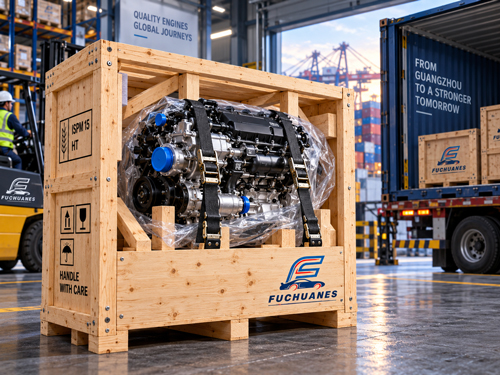
ISPM 15 Packaging: The Global Standard Behind Every Crate
Any buyer moving an engine across borders will encounter one acronym repeatedly: ISPM 15 packaging. It refers to International Standards for Phytosanitary Measures No. 15, the regulation issued under the International Plant Protection Convention (IPPC) that governs how solid wood packaging material may be used in international trade. The concern behind the rule is pests: untreated wood can carry insects, larvae, and fungal pathogens that hitch a ride across borders inside pallets and crates.
Under ISPM 15, all solid wood packaging—crates, pallets, dunnage, and skids thicker than 6 millimeters—must be debarked and either heat-treated to a core temperature of 56°C for a minimum of 30 minutes or fumigated with methyl bromide. Treated wood carries a permanent stamp showing the IPPC symbol, the ISO country code of the treatment facility, the producer's registration number, and the treatment method, typically "HT" for heat treatment. A crate without this mark is at risk of being rejected, held for inspection, or destroyed at the destination port, and the importer—not the shipper—absorbs the cost and the delay.
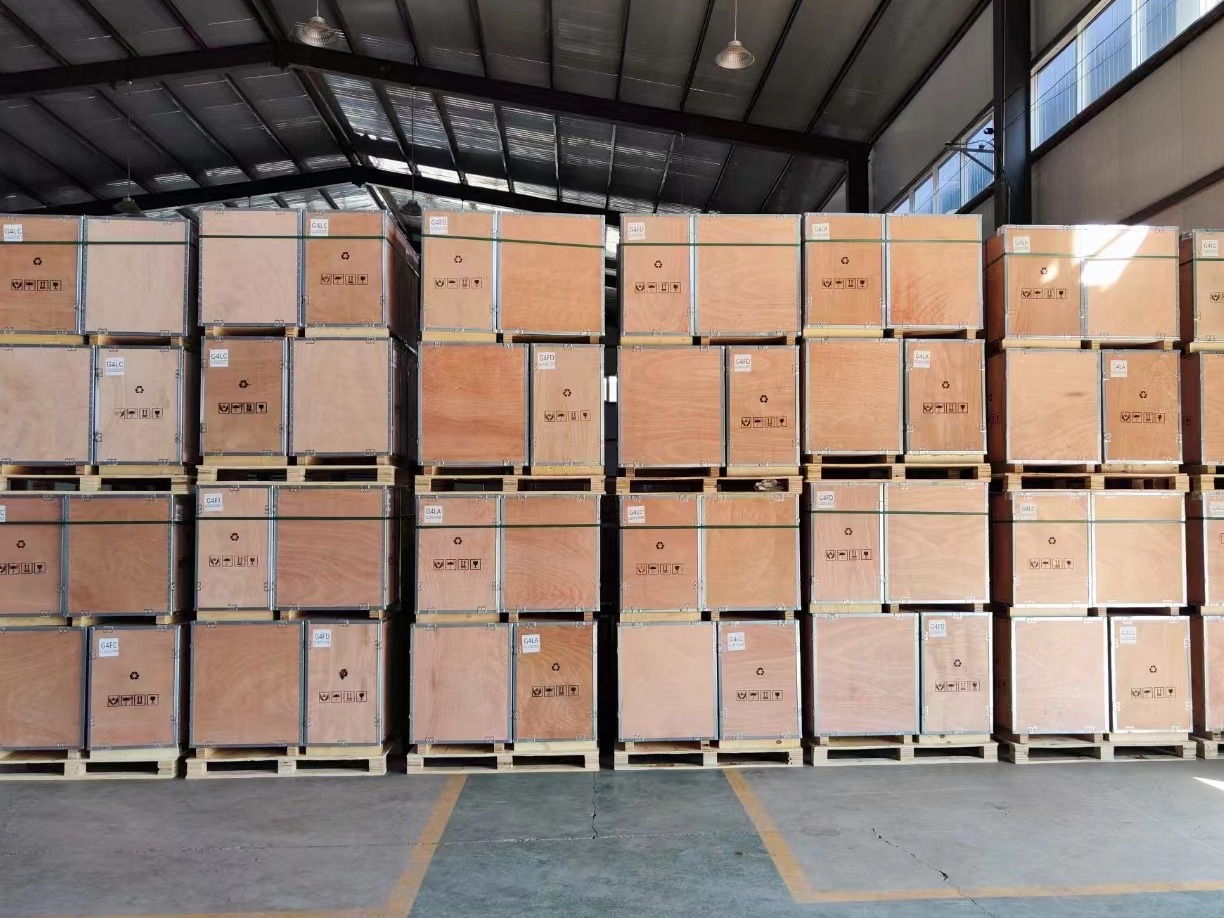
For engine buyers, this standard is more than a compliance box to tick. Heat-treated wood is also dimensionally stable wood. The kiln-drying process reduces moisture content, which means the crate is less likely to warp, split, or shift under load during a long voyage. When Fuchuan crates an engine, the ISPM 15 packaging is built to the load: a heavy V6 or V8 gets a reinforced base with steel fasteners and internal bracing, while a bare cylinder head or block is mounted to a dedicated fixture so no machined face ever bears weight. The result is a package that satisfies both the phytosanitary inspectors and the structural demands of a multi-thousand-kilometer journey.
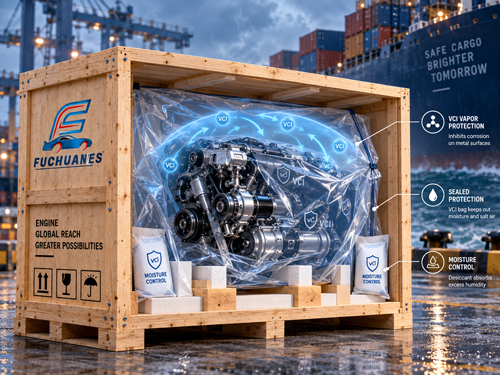
VCI Rust Protection: The Invisible Shield Inside the Crate
Moisture is the single greatest enemy of an engine in transit, and no wooden crate—however well built—is airtight. Ocean containers sweat. Temperature swings between day and night, or between tropical loading ports and temperate discharge ports, cause condensation to form inside the crate, and that condensation settles directly onto the engine's machined surfaces. A crankshaft journal or a freshly honed cylinder bore can begin to rust within days of sustained humidity, and surface rust on a sealing face is a warranty problem waiting to happen.
Fuchuan addresses this with VCI, or Vapor Corrosion Inhibitor, protection. VCI materials release a faint, invisible vapor that condenses onto exposed metal surfaces and forms a molecular barrier only a few molecules thick. That barrier disrupts the electrochemical reaction that causes oxidation, protecting ferrous metals and many non-ferrous alloys alike. VCI bags, films, and emitters are placed inside the crate so that the entire assembly—not just the external surfaces—is continuously protected, including the internal surfaces of ports and galleries that are impossible to reach with a spray.
The advantage of VCI over traditional methods is that it is clean and self-healing. Grease and cosmoline are effective but messy and require laborious removal before installation. VCI protection, by contrast, simply dissipates when the packaging is opened, leaving no residue on the engine. It also re-forms its protective layer automatically if the barrier is momentarily disturbed, which matters when a crate is opened for a spot inspection at the port. For a buyer, the practical takeaway is simple: ask your supplier what rust-inhibition method is used inside the crate, because a supplier that ships a bare engine in a wooden box is transferring the cost of corrosion directly to you.
Sea Freight vs. Air Freight: Choosing the Right Lane for Your Engine
Not every engine shipment should go by sea, and not every engine shipment should fly. The right choice is a function of weight, urgency, and unit economics, and a competent engine export partner will recommend rather than simply ask you to pick.
| Factor | Sea Freight (FCL/LCL) | Air Freight |
|---|---|---|
| Transit time | 15–40 days depending on route | 3–7 days |
| Cost per kilogram | Low—the default for engine shipping | High—often 5–10x sea freight |
| Best for | Full containers, scheduled stock orders, remanufactured programs | Samples, warranty replacements, urgent AOG (aircraft-on-ground style) needs |
| Weight handling | Handles multi-hundred-kilogram crates easily | Dim-weight and actual-weight pricing punish heavy cargo |
| Handling risk | More handling transfers, longer exposure | Fewer transfers, shorter exposure, but higher per-unit scrutiny |
For the overwhelming majority of engine export orders, sea freight is the economic default. A complete engine crate is heavy and dense, which is exactly the kind of cargo ocean carriers price favorably. Full container load (FCL) shipping becomes cost-effective once a buyer is moving multiple engines, while less-than-container-load (LCL) consolidation suits single-unit or mixed orders. Air freight earns its place in three scenarios: an urgent warranty replacement that cannot wait for a sailing, a prototype or sample that a buyer needs for evaluation, or a high-value custom build where the shipping cost is a rounding error against the engine's value.
Fuchuan's export team quotes both lanes on request and maps the realistic transit window for each, so a buyer never discovers the true delivery date after committing. The 35-day benchmark in this article refers to a representative ocean shipment from Guangzhou to a mid-haul destination; shorter and longer routes adjust accordingly.
The 35-Day Engine Export Timeline: Factory Gate to Destination Port
A reliable engine export operation runs on a schedule, not on hope. The table below breaks the representative 35-day window into its constituent stages, from order confirmation to cargo availability at the destination port.
| Day | Stage | What Happens |
|---|---|---|
| 1–2 | Order confirmation | Spec, quantity, destination, and Incoterm confirmed; production or dedicated stock allocation begins |
| 3–5 | Engine preparation | 100% cold test, fluid drain, port blanking, and final inspection against the order sheet |
| 6–7 | VCI + ISPM 15 crating | VCI film and emitters applied; engine bolted into a heat-treated ISPM 15 crate with internal bracing |
| 8–9 | Inland transport | Crate trucked from Guangzhou to the departure port (Nansha/Shenzhen) with lashing and tarp protection |
| 10–11 | Export clearance | China export declaration, container loading, and lashing; commercial and shipping documents prepared |
| 12–30 | Ocean voyage | Transit time varies by destination—roughly 12–18 days to Southeast Asia, 15–20 to the Middle East, 25–35 to Europe and North America |
| 31–35 | Arrival and availability | Vessel discharge, destination customs clearance, and cargo made available for the buyer's own transport |
Two things should stand out from this timeline. First, the longest single block is the ocean crossing, and it is also the block the shipper controls least. That is precisely why the packaging and documentation stages in the first two weeks matter so much: they are the parts of the process where a disciplined supplier can de-risk everything that follows. Second, a genuine 35-day engine export is not a single action but a sequence of handoffs. Every handoff is a place where information can be lost and delays can creep in. Fuchuan assigns a single export coordinator to each order so that the buyer has one point of contact through the entire chain, from the crate being sealed in Guangzhou to the container being discharged abroad.

The Customs Clearance Documents You Cannot Afford to Get Wrong
An engine clears borders on paper before it clears them physically. A missing signature, an inconsistent harmonized-system (HS) code, or a mismatch between the invoice and the packing list can hold a container at the port for days—or weeks—while demurrage fees accrue. A buyer who understands the document set is a buyer who can spot a weak supplier before the cargo is ever loaded.
The core document set for a clean engine export shipment includes:
- Commercial Invoice — the definitive statement of what is being sold, at what price, and on what terms. It must match the purchase order and the packing list exactly.
- Packing List — the physical manifest of the shipment: crate count, dimensions, gross and net weight, and the engine serial numbers inside.
- Bill of Lading (B/L) — the contract of carriage and the title document for ocean freight; an Air Waybill (AWB) serves the same role for air freight. It is the document that transfers control of the cargo.
- Certificate of Origin — proof of where the goods were manufactured, which determines duty treatment under the destination country's trade agreements and preferences.
- ISPM 15 compliance evidence — the heat-treatment mark on the wood itself is the primary proof, but a treatment certificate is often requested alongside it.
- Export declaration — filed with Chinese customs to authorize the outbound shipment.
Depending on the destination, additional items may apply: pre-shipment inspection certificates, destination import permits, fumigation certificates, or insurance certificates. Fuchuan prepares the standard set for every order and flags any destination-specific requirement up front, because the cheapest way to fix a documentation problem is to prevent it before the container sails.
What to Look For in an Engine Export Partner
If you are evaluating a new engine supplier, treat their logistics capability as a leading indicator of everything else. A supplier who has thought hard about packaging, corrosion, and documentation has almost certainly thought hard about the engine itself; the two disciplines attract the same kind of organization.
Three questions will tell you most of what you need to know. First, how is the engine protected inside the crate? The answer should name VCI protection and a load-rated, ISPM 15-marked crate—not vague assurances about "careful handling." Second, can you show me the document set for a past shipment? A supplier who can produce a clean, consistent invoice, packing list, and bill of lading for a previous export is demonstrating process, not improvisation. Third, who owns the inland leg and the export clearance? The handoff between factory and port is where most damage and delay originate, so a partner who manages that leg end-to-end removes the most common point of failure.
These questions matter because the freight forwarder moves the cargo, but the supplier's preparation determines whether that cargo arrives as an engine or as an expensive problem.
From Guangzhou to the World: The Fuchuan Engine Export Standard
Every crate that leaves Fuchuan Engine's Guangzhou facility carries the same preparation, whether it is a complete engine assembly, a machined cylinder head, a bare cylinder block, or a replacement turbocharger. The standard is simple to state and harder to execute: 100% testing before crating, VCI rust protection inside, a load-rated ISPM 15 crate outside, a documented export declaration, and a single coordinator who owns the order to the destination port. It is the same discipline that supports our 800+ vehicle applications in stock, our 12-month warranty, and our OEM/ODM custom builds.
For buyers and distributors ready to build a reliable supply line, the global agent program extends that standard into regional distribution, with authorized status, pricing support, and technical training—so the engine you order arrives the way every engine should: tested, protected, and documented, on the schedule you were promised.
If you are planning an engine export order and want a realistic timeline, a complete document set, and a shipping partner who treats your engine like precision equipment rather than bulk cargo, contact Fuchuan Engine for a freight-inclusive quote. A well-shipped engine is the first thing your customer sees—and it is the first impression your supplier either earns or squanders.
Engine Distributor Success: How a Middle East Partner Scaled with Fuchuan
Inside Fuchuan Engine's 12-Month Warranty: The Quality Control Behind Every Tested Engine
Related Article