Inside Fuchuan Engine's 12-Month Warranty: The Quality Control Behind Every Tested Engine
A warranty is a promise, and in the engine trade a promise is only worth what its testing supports. Fuchuan Engine's 12-month engine warranty is not a marketing line—it is the legal and commercial expression of an engine quality control program that runs from the moment a core enters the facility to the day a crate is sealed for export. Every engine passes through the same gauntlet: dimensional verification, dynamic balancing, leak and seal testing, a 100% cold-test on every unit, and a hot-test sampling program on top of it. For buyers, importers, and distributors, understanding exactly what sits behind that warranty matters more than the number of months printed on the certificate, because it determines whether a claim ever needs to be made at all. This article walks through the testing pipeline in detail and explains why it should change how you evaluate any engine supplier.
Why a Warranty Is Only as Good as Its Testing
Engine quality control and warranty are two sides of the same coin. A supplier can offer a 24-month or 36-month warranty and still deliver engines that fail in the first week, because the warranty itself fixes nothing—it only defines who pays when testing was inadequate. Conversely, a modest 12-month warranty backed by disciplined testing delivers something far more valuable: an engine that does not fail in the first place.
The economics are instructive. A single in-field engine failure costs a distributor far more than the part. There is the freight to return the unit, the downtime of the customer's vehicle, the labor to remove and reinstall, and the reputational damage that follows a warranty claim to a fleet manager. The industry rule of thumb is that a warranty claim costs five to ten times the value of the component that failed. Testing is therefore not a cost center—it is the cheapest insurance a supplier can buy, and the highest-value line item a buyer can verify.
This is why Fuchuan inverts the usual logic. Rather than testing to catch defects at the end, the company tests continuously, at every stage where a defect can be introduced, so that a substandard engine never reaches the point where a warranty claim becomes possible.

The Quality Control Pipeline: Five Gates to Pass
Every engine that leaves Fuchuan's Guangzhou facility—whether a brand-new engine assembly, a remanufactured unit, or an OEM/ODM build—must clear five verification gates. Skipping any one of them is not an option, because each gate catches a failure mode the others cannot.
Gate 1: Incoming Inspection and Core Selection
For remanufactured engines, quality begins before any work is done. Each used core is triaged against a written acceptance standard: block deck flatness, bore taper and out-of-round, crankshaft journal wear, and visible cracking in the head or block. Cores that fall outside tolerance are rejected outright rather than "repaired" into a short-lived engine. This is the single biggest differentiator between a genuine remanufacturer and a shop that merely washes and reassembles used parts. A cylinder block that has been overheated may look fine on the outside but have a cracked deck that only reveals itself under load—a defect that no amount of downstream testing can undo.
Gate 2: Dimensional and Surface Verification
After machining, every critical surface is measured, not eyeballed. Bore diameter is checked against specification with calibrated instruments, deck flatness is verified against a granite reference, and crankshaft bearing clearances are confirmed with precision measuring. The reason is simple: an engine is a stack of tolerances, and a few microns of error at the machine shop becomes a seized bearing or a blown head gasket on the road. On the cylinder head, valve seat concentricity and surface finish are checked because they govern both compression sealing and oil control.
Gate 3: Dynamic Balancing
Rotating assemblies—crankshaft, flywheel, and the balancer—are dynamically balanced to specification. Imbalance is not just a comfort issue; at several thousand rpm, an out-of-balance rotating assembly transmits cyclic stress into the main bearings and block, accelerating wear and eventually cracking components. Dynamic balancing is one of the quietest but most consequential steps in the entire engine testing sequence, because its effects accumulate over tens of thousands of kilometers rather than appearing on a test stand.
Gate 4: Leak and Seal Testing
An engine is a sealed system, and every seal is a potential failure point. Fuchuan pressure-tests the cooling system, the lubrication galleries, and the combustion chambers to confirm integrity before any fluid ever flows under operating conditions. A block with a micro-crack or a head gasket surface that is not perfectly flat will fail this gate long before it would fail in service. Leak testing is cheap, fast, and catches exactly the defects that produce the most frustrating warranty claims—slow coolant loss, oil weeping, and compression leaks that degrade performance gradually.
Gate 5: Cold Testing and Hot Testing
The final two gates are the headline tests, and they work together. Cold testing is performed on 100% of engines. Hot testing is performed on a sampled basis and on every custom or high-performance build. The distinction matters, and it is worth a dedicated explanation.
The 100% Cold Test: Why Every Engine Gets Tested
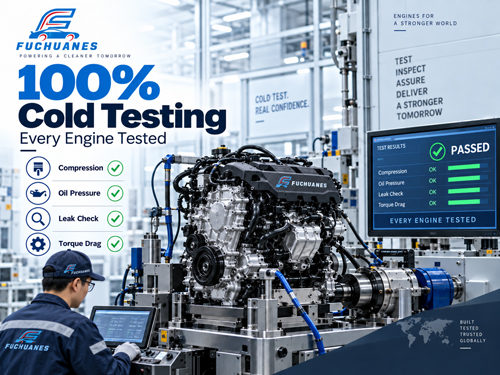
Cold testing is the backbone of modern engine quality control, and it is precisely why Fuchuan can stand behind a 12-month warranty on every unit rather than just a subset. In a cold test, the engine is driven by an external motor—no fuel, no spark, no combustion—while sensors measure a battery of parameters in real time.
The value of cold testing is that it is repeatable and data-rich. Because the test runs under controlled conditions without the noise and variability of combustion, it can detect anomalies that a hot test would mask or that would otherwise surface only as an intermittent fault weeks later. Among the parameters measured are crankshaft torque and drag, which reveal bearing tightness and machining error; compression uniformity across cylinders; oil-pressure build-up and flow; and vacuum and seal integrity in the intake and crankcase.
Crucially, cold testing is fast and non-destructive, which is what makes 100% coverage economically feasible. A well-instrumented cold test takes minutes, leaves no residue, and does not subject the engine to a thermal cycle before its first real start. That last point matters: a cold-tested engine reaches its first customer with its break-in cycle intact, rather than partially consumed on a test stand.
For the buyer, the practical takeaway is unambiguous: a supplier that cold-tests every engine has already eliminated the gross defects before shipping. When a distributor asks "how do you prevent bad engines from reaching me," the answer is not a promise—it is a test log.
Hot Testing: When Combustion Is the Only Honest Judge
Cold testing catches most defects, but combustion introduces loads, temperatures, and vibrations that no motored test can fully replicate. This is where hot testing enters. A hot test runs the engine on fuel under load, confirming that it starts, idles, builds boost (where applicable), holds oil pressure at operating temperature, and produces power and emissions within specification.
The reason hot testing is sampled rather than universal is a matter of engineering judgment and economics. Running every engine on fuel adds cost, consumes break-in life, and introduces heat cycles. For standard production and remanufactured units, a disciplined hot-test sampling program—plus full cold-test coverage—provides the right balance of assurance and value. For turbocharged engines, performance builds, and any unit where a customer specifies it, hot testing becomes mandatory, because boost pressure and high-temperature sealing can only be validated under real combustion.
The distinction is important for buyers to understand: a supplier who cold-tests 100% and hot-tests selectively is not cutting corners—they are applying the right test to the right risk. The question to ask is never "do you hot test?" but "what triggers a hot test, and what do you measure when you run one?"
What the 12-Month Warranty Actually Covers
A warranty is only as useful as its terms are clear. The table below summarizes what Fuchuan's 12-month engine warranty covers and the conditions that keep it valid.
| Coverage Element | What Is Included |
|---|---|
| Duration | 12 months from shipment (standard terms) |
| Scope | Manufacturing and material defects across the complete engine |
| Parts | Replacement of the defective engine or component at Fuchuan's election |
| Exclusions | Improper installation, failure of external systems, misuse, neglected maintenance |
| Activation | Correct installation and initial oil/filter service performed to specification |
| Claim Process | Documented evidence, inspection, and rapid resolution through your account manager |
Two points deserve emphasis. First, the warranty covers manufacturing and material defects—in other words, the things the five test gates are designed to catch. It is a warranty on workmanship, not a promise that covers abuse. Second, the terms are built to be enforceable and fast: a documented claim with clear evidence is resolved quickly, because the testing data exists to confirm or localize the fault. A warranty that is easy to claim is a warranty that is easy to trust.

Why Testing Matters to Your Bottom Line
For a purchasing manager, engine testing is not an abstraction—it is a line item in total cost of ownership. Every percentage point of defect reduction is a percentage point off your own after-sales burden. Consider the compounding effect: a distributor importing fifty engines a quarter who cuts the failure rate from three percent to half a percent saves not just the cost of two engines, but the freight, labor, and customer goodwill attached to two failed units, quarter after quarter.
Testing also protects the relationship. In B2B engine trade, the buyer's reputation is downstream of the supplier's. A workshop that fits a tested engine and never sees it again becomes a loyal, reordering customer. A workshop that fits a defective engine tells ten others. The 12-month warranty is the contract; the testing program is the thing that keeps the contract from ever being invoked.
This is the standard to hold any supplier to: ask for the test data, not just the warranty document. A supplier who can show you a cold-test log, a balancing certificate, and a hot-test report is a supplier who is measuring its work. A supplier who offers a longer warranty but cannot show you how an engine was verified is offering you a bet, not a product.
Questions Buyers Ask About Engine Testing
A few questions recur in nearly every procurement conversation, and the answers are worth stating plainly.
"How do I know a specific engine was actually tested?" Every tested engine carries a unique identifier, and the test results are recorded against that identifier. A buyer can request the test data for their own order—the cold-test log, the balancing certificate, and, where applicable, the hot-test report. Documentation that can be tied to a specific serial number is the strongest proof a supplier can offer.
"Does 100% cold testing mean no engine can fail?" No test program eliminates risk entirely; it drives it toward zero by removing the defects that are detectable before shipping. The residual risks—an installation error, a failed external component, an abused unit—are exactly what a clearly scoped warranty is designed to address. Testing and warranty work together: testing minimizes the need for claims, and the warranty defines the terms when a genuine defect slips through.
"Why not just hot-test everything?" Hot testing is excellent at validating combustion behavior, but it is slower, costlier, and consumes a portion of the engine's break-in life. The industry's proven approach is full cold-test coverage for every unit plus targeted hot testing where combustion validation adds the most value—turbocharged and performance builds, and any customer-specified requirement. The combination is what lets a supplier offer a genuine warranty on every engine rather than on a lucky subset.
From Testing Bench to Global Market
Fuchuan Engine has built more than a decade of engine supply on this foundation: 800+ vehicle applications in stock, 100% testing, and a 12-month warranty that is honored across the markets it serves. Every engine—new, remanufactured, or custom—passes through the same gates, because a global buyer in Lagos deserves the same assurance as a distributor in Hamburg.
For businesses ready to build on that foundation, the global agent program extends the same quality commitment into regional distribution, with authorized status, pricing support, and technical training that help partners sell with the confidence of a documented testing program behind every unit.
The next time you evaluate an engine supplier, do not start with price and end with the warranty clause. Start with the test log. Ask how every engine is verified before it is crated, what happens to the ones that fail, and whether the warranty is backed by data or by adjectives. The answers will tell you everything the brochure will not—and they will tell you whether that 12-month promise is worth the paper it is written on.
Explore the full range of tested engines and components, or contact Fuchuan Engine to request a testing report and a quote for your next order.
Engine Export Logistics: How Fuchuan Ships Engines Worldwide in 35 Days
OEM/ODM Custom Engine Manufacturing: How Fuchuan Engineers Your Vision Into Reality
Related Article