Turbocharger Technology: From Single-Scroll to Electric Turbocharging
How a Turbocharger Works: The Foundation
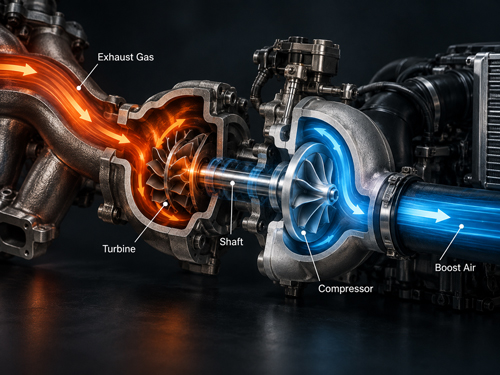
Before comparing generations of turbocharger technology, it helps to fix the underlying physics. A turbocharger is a shaft-mounted pair of aerodynamic wheels: a turbine on the hot side and a compressor on the cold side. Exhaust gas leaving the engine spins the turbine, which drives the compressor through a common shaft, and the compressor forces a denser charge of air into the cylinders. More air means more fuel can be burned, which means more power from the same displacement.
Three parameters dominate a turbo's behavior. The first is spool threshold, the engine speed at which the turbo begins producing meaningful boost. The second is boost response, or how quickly pressure builds after the throttle opens—what drivers experience as lag. The third is efficiency, the ratio of useful compression work to the energy extracted from the exhaust stream, which governs both power and heat. Every innovation described in this article is, at root, an attempt to push the spool threshold lower, cut response time, and hold efficiency high across a wider operating window.
The core trade-off has never changed: a turbine large enough to flow massive air at high rpm is slow to spool at low rpm, while a small turbine that spools instantly chokes at the top end. Every generation of turbocharger technology has been a different answer to that same riddle.
Stage 1: The Single-Scroll Turbocharger
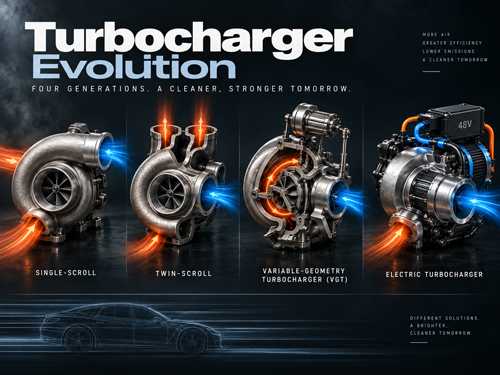
The single-scroll turbocharger is the oldest and most widely produced design, and it remains the default on hundreds of millions of engines today. The name comes from the turbine housing: a single, spiraling volute that collects exhaust pulses from all cylinders and feeds them to one turbine wheel.
Its virtues are simplicity and cost. A single-scroll housing is cheap to cast, easy to package, and mechanically robust. Because it has no moving parts inside the housing, there is little to fail beyond the bearings and seals. This is why it dominates entry-level and mid-range applications, from the small gasoline engines of economy cars to the heavy-duty diesels of commercial trucks.
Its weakness is equally well understood: pulse interference. In a four-cylinder engine firing every 180 degrees of crank rotation, exhaust pulses arrive at the turbine in a staggered, overlapping rhythm. As each cylinder's exhaust valve opens, its pressure pulse crashes into the residual pressure of the previous cylinder's pulse still circulating in the volute. The result is turbulence, backpressure, and wasted energy—precisely at low rpm, where spool is slowest. Engineers mitigate this by sizing the turbine for a compromise, accepting either sluggish low-end response or a ceiling on top-end flow.
For buyers, the single-scroll turbo is the value workhorse. It is the cheapest unit to replace, the easiest to source, and the most forgiving of marginal oil-change discipline—provided the bearing cartridge is not overheated. When a customer brings in a failed turbo on a mainstream sedan or a work truck, a quality single-scroll replacement from a turbocharger replacement line is almost always the correct, cost-effective call.
Stage 2: The Twin-Scroll Turbocharger
The twin-scroll turbo attacks the pulse-interference problem directly by splitting the turbine housing into two separate scrolls and pairing cylinders so their exhaust pulses never collide. In a four-cylinder engine, cylinders 1 and 4 are grouped into one scroll and cylinders 2 and 3 into the other; in an inline-six, the pairing is 1-2-3 and 4-5-6. Because cylinders feeding the same scroll are separated by a full 360 degrees of crank rotation, each pulse has time to clear the volute before the next one arrives.
The effect is dramatic. A twin-scroll turbo typically reaches full boost 300 to 600 rpm earlier than an equivalent single-scroll unit and holds response flatter across the midrange. This is why the design became the signature of BMW's N54, N55, and B58 inline-sixes, and why it underpins the "small engine, big feel" character of countless modern turbocharged four-cylinders. The pairing also scavenges more energy from the exhaust, improving both fuel economy and emissions without adding a second turbo's worth of weight.
The trade-off is complexity and cost. The divided housing is harder to cast, the exhaust manifold must be designed with the correct pairing in mind, and there is no way to retrofit a twin-scroll housing onto a manifold engineered for a single-scroll unit. It also does not eliminate lag—it merely narrows it. For a distributor, the practical message is that a twin-scroll turbo is not interchangeable with a single-scroll unit on the same engine; the manifold, plumbing, and often the engine calibration all differ.
Where the single-scroll is a commodity, the twin-scroll turbo is a genuine upgrade decision. When a fleet operator complains about off-idle lag on a B58-powered vehicle, the correct diagnosis is rarely "fit a bigger turbo"—it is "preserve the twin-scroll architecture, and match the unit to the engine family." A supplier who understands that distinction—and can supply the correct engine assembly or the right cylinder head to match—earns the customer's trust far faster than one who treats every turbo as a generic part.
Stage 3: Variable Geometry Turbochargers (VGT)
If the twin-scroll split the exhaust into two paths, the variable geometry turbocharger makes the turbine itself adaptive. A VGT—also called a variable nozzle turbine, or VNT under Garrett's naming—places a ring of movable vanes around the turbine wheel. At low rpm, the vanes close down, narrowing the throat through which exhaust flows; the gas accelerates, striking the turbine blades at high velocity and spinning it up almost like a small turbo. As rpm rises, the vanes open progressively, enlarging the throat so the turbine behaves like a large turbo at the top end.
This is the closest a pure exhaust-driven turbo has come to having it both ways. A well-tuned VGT effectively eliminates the low-end/top-end compromise, which is why it became the default on modern common-rail passenger diesels and is now migrating into gasoline engines, particularly in Europe where its contribution to emissions compliance is valuable.
The cost is mechanical sophistication. Those movable vanes operate in a 900–1,000 °C exhaust stream, where carbon, soot, and thermal cycling conspire against them. Early gasoline VGTs struggled precisely because gasoline exhaust runs hotter than diesel and can push the vane mechanism past its material limits—a lesson the industry learned at some expense. VGTs also demand precise electronic actuation and more sophisticated engine calibration, raising the skill bar for diagnosis and repair.
For the aftermarket, VGT durability is the recurring question. A VGT that has been driven gently and fed clean, correct-grade oil will typically outlast the vehicle's first engine; one that has been short-tripped, over-fueled, or run on degraded oil will soot up its vane ring and throw boost-control faults. Buyers evaluating a used VGT-equipped engine should ask directly about maintenance history, and should treat persistent actuator or vane codes as a signal to budget for replacement. When replacement is the answer, matching the turbo to the exact engine calibration—rather than a visually similar unit—is non-negotiable.
Stage 4: The Electric Turbocharger
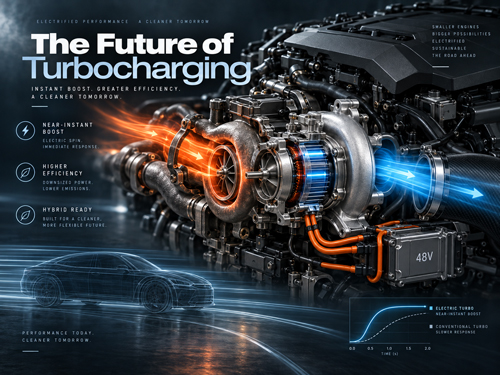
The electric turbocharger is where forced induction finally escapes the limitations of exhaust energy altogether. The core idea is deceptively simple: mount a high-speed electric motor on the shaft between the turbine and compressor, or drive a separate electrically powered compressor, so that boost can be generated on demand regardless of engine speed. At low rpm, when exhaust flow is too weak to spin the turbine, the motor does the work, eliminating lag almost entirely. At high load, the motor can hold the compressor at its efficiency sweet spot while the turbine recovers waste energy—and, in regenerative designs, convert surplus exhaust energy back into electricity for a 48-volt system.
The technology has moved from prototype to production in a remarkably short span. Garrett's E-Turbo first reached production on a 2.0-liter Mercedes-AMG application, and Porsche subsequently integrated an electric turbo between the turbine and compressor wheels on the 911 GTS. BorgWarner has pursued a parallel path with the eBooster—a standalone electrically driven compressor—plus its own integrated eTurbo for 48-volt mild-hybrid platforms. In 2025 and 2026, these systems began cascading from flagship performance cars into hybrid and downsized mainstream engines as costs fall and durability improves.
The performance case is compelling: throttle response approaching that of a naturally aspirated engine, low-end torque on demand, and up to double-digit percentage gains in fuel efficiency in some gasoline applications. The engineering case is harder. An electric turbo adds a motor, power electronics, cooling, and a high-voltage or 48-volt supply, and it must survive sustained 1,000 °C turbine temperatures while spinning at well over 100,000 rpm. That is a demanding environment for any electric machine.
For today's buyer, the electric turbocharger is still mostly a forward-looking concern: it is engineered into new platforms rather than bolted onto legacy ones, and aftermarket availability remains thin. But the writing is on the wall. As hybrid and downsized powertrains spread, electric assistance to forced induction will become as routine as the wastegate is today. A distributor who begins building literacy in e-turbo architectures now—how the motor integrates, what the 48-volt interface looks like, what fails first—will be positioned for the next decade of parts demand, not just this one.
A Generational Comparison at a Glance
The table below summarizes the four stages side by side, so buyers can map a symptom to the right technology conversation.
| Attribute | Single-Scroll | Twin-Scroll | VGT / VNT | Electric Turbo |
|---|---|---|---|---|
| Spool threshold | High | Medium | Low | Very low (motor-assisted) |
| Boost response (lag) | Noticeable | Reduced | Minimal | Near-instant |
| Top-end flow | Good | Better | Best (adaptive) | Good (motor-constrained) |
| Moving parts in exhaust | None | None | Movable vanes | Motor + electronics |
| Relative cost | Low | Medium | High | Very high |
| Typical application | Economy cars, trucks | BMW I6, modern I4 | Diesel, Euro gasoline | Hybrid, performance flagship |
| Aftermarket availability | Abundant | Good | Moderate | Limited |
A few patterns stand out. First, cost and complexity rise monotonically from single-scroll to electric—there is no free lunch. Second, each step is a genuine response to a real driving problem, which is why none of the four has fully displaced the others; they coexist because different applications value different attributes. Third, the aftermarket lags the OEM market by a widening gap as technologies become more integrated, which means sourcing discipline matters more, not less, at the upper end of the table.
What This Means for Engine Buyers and Importers
For a purchasing manager or distributor, the technology ladder is not a trivia list—it is a decision framework. Three questions translate almost any turbo-related inquiry into a workable order.
The first is application: is the customer replacing a failed unit on a fleet vehicle, or specifying components for a build? A failed turbo on a mainstream diesel points to VGT; a performance gasoline engine points to twin-scroll; a hybrid project points toward electrification. The second is matching: a turbo is not a standalone part but a system, tied to the manifold, the calibration, and the cylinder block and head it breathes through. The third is quality assurance: a turbo that has not been balanced, pressure-tested, and inspected will destroy the very engine it was meant to boost, so sourcing from a supplier with documented testing is non-negotiable.
This is where a specialist manufacturer earns its place. Fuchuan Engine has spent more than a decade supplying complete engines, cylinder heads, blocks, and turbochargers to buyers across more than 800 vehicle applications, with every unit subjected to 100% testing and backed by a 12-month warranty. For customers whose needs go beyond off-the-shelf components, the company's OEM/ODM service can engineer a turbocharged powertrain package to a specific duty cycle—matching turbine sizing, intercooling, and calibration to the application rather than selling a generic part. And for distributors ready to build a regional business around forced-induction and engine supply, the global agent program offers regional authorization, pricing support, and technical training.
The Road Ahead
Turbocharger technology has spent a century solving the same fundamental problem—how to get big-engine output from a small package—and it is not finished. The near term belongs to electrification: 48-volt assistance will spread from flagships to volume models, and regenerative e-turbos will blur the line between a boosting device and a hybrid's energy-recovery system. Slightly further out, hydrogen combustion and advanced gasoline engines will demand turbochargers that tolerate higher temperatures and leaner mixtures, pushing materials science as hard as aerodynamics. Through all of it, one constant remains: the turbo is only as good as the engine it feeds, and the engine is only as good as the supplier who stands behind both.
Whether your customer needs a straightforward replacement, a matched engine-and-turbo package, or a custom forced-induction program for a new market, the conversation starts with a single question about the application—and it ends at a supplier who understands every stage of the technology ladder. Explore the full range of tested engines and turbochargers at Fuchuan Engine, or reach out through the global agent program to discuss a partnership built for the decade ahead.
Engine Selection Guide: How to Match the Right Engine to Your Vehicle
2026 Global Automotive Engine Market: Size, Trends, and Regional Demand Shifts
Related Article