Engine Selection Guide: How to Match the Right Engine to Your Vehicle
Choosing the correct replacement engine is the single most important decision in any engine purchase, yet it is also where buyers make the most expensive mistakes. This engine selection guide walks you through the entire matching process, from reading a vehicle's identification data to verifying engine compatibility before you commit to an order. Whether you are a distributor stocking multiple engine families, a repair shop fitting a customer's vehicle, or a private enthusiast rebuilding a project car, the principles are the same: identify the exact specification, confirm the mounting and electrical interfaces, and source from a supplier that guarantees a tested, warranted unit. Get this wrong and you are left with a heavy, expensive component that will not bolt in, will not start, or will not pass inspection. Get it right, and a correct engine match restores a vehicle to factory performance at a fraction of the cost of a new vehicle.
The good news is that engine matching is a methodical, learnable process rather than a mystery. Once you understand the handful of data points that define an engine, you can select with confidence. This guide explains those data points, shows you how to read them from a vehicle, and provides a practical reference to avoid the most common compatibility pitfalls.
Why Precise Engine Matching Matters
An engine is not a universal component. Even within a single vehicle model, a manufacturer may offer several different engines across trim levels, model years, and regional markets. A Toyota Camry, for example, has been offered with four-cylinder and V6 options, in gasoline and hybrid forms, and with displacements ranging from 2.0 to 3.5 liters depending on the market and generation. Ordering "a Camry engine" without specifying the rest is a recipe for a mismatch.
The consequences of poor engine selection fall into three categories:
- Physical incompatibility — The engine block, mounting points, bell-housing pattern, or accessory brackets do not line up, making installation impossible without expensive fabrication.
- Electrical and control incompatibility — The engine management system, sensors, wiring harness, and ECU expect a different specification, so the engine runs poorly or refuses to start.
- Regulatory and warranty problems — A wrong-displacement or wrong-emission-standard engine can fail inspection and void the warranty coverage that a reputable supplier offers.
Precise engine compatibility checking is therefore not optional. It is the difference between a smooth transaction and a costly dispute. This is exactly why a professional supplier builds its catalog around exact identification rather than vague model names.
The Five Data Points That Define an Engine
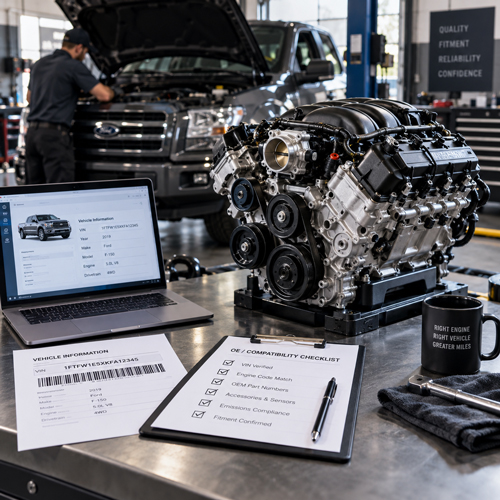
Every internal combustion engine can be pinned down by five pieces of information. Collect all five and your selection will almost always be correct.
1. Vehicle Make, Model, and Generation
Start with the basics: the manufacturer, the model, and the generation or platform code. Generation matters because a model that shares a name across two decades may use completely unrelated engine families. The gap between a fifth-generation and an eighth-generation Honda Accord, for instance, spans entirely different engine architectures.
2. Model Year and Region
The same nominal model can switch engines mid-cycle. A facelift, an emission-regulation change, or a regional variant can all alter the specification. Always confirm the exact production year and the market the vehicle was built for (for example, Gulf, European, North American, or domestic China specification), because emission standards and engine codes differ by region.
3. Engine Code and Family
The engine code is the most precise identifier. Codes such as Toyota's 2ZR-FE, BMW's B48, Nissan's VQ35DE, or Volkswagen's EA888 identify a specific engine family and generation. When you can quote the exact engine code, the risk of mismatch drops dramatically. A reputable supplier will ask for this code first.
4. Displacement and Fuel Type
Displacement, expressed in liters or cubic centimeters (for example, 2.0L or 1998cc), plus the fuel type — gasoline, diesel, hybrid, or LPG — narrows the field further. A 2.0L turbocharged gasoline engine and a 2.0L diesel are entirely different units despite sharing a displacement figure.
5. OE Part Number
The original equipment (OE) part number is the gold standard of engine matching. Stamped on the block or listed on the engine's build plate, the OE number maps one-to-one to a specific production specification. If you have the OE number, you can often skip much of the guesswork entirely. Suppliers cross-reference OE numbers against their catalogs to confirm an exact replacement.
How to Read a Vehicle's Engine Data
Knowing the five data points is useful only if you can find them on the vehicle. Here is where to look.
The VIN (Vehicle Identification Number)
The VIN is a 17-character code stamped on the dashboard, the driver's door jamb, and the engine bay. Positions within the VIN encode the manufacturer, the vehicle attributes, and — in many cases — the engine code or a character that maps to it. A VIN decoder can reveal the engine family, displacement, and sometimes the exact engine code. This is the fastest way to begin engine selection.
The Engine Bay Plate and Block Stamping
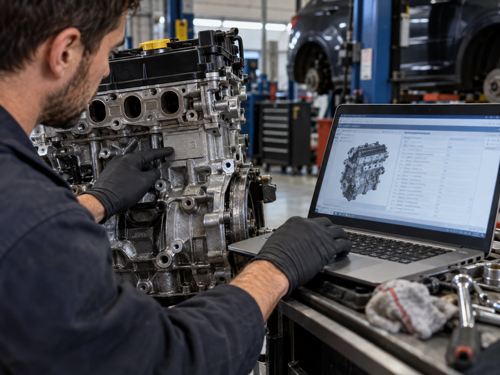
The engine itself often carries the code. Manufacturers stamp the engine code directly onto the cylinder block or a plate fixed to the block or the cylinder head. On many Japanese engines, the code appears on a flat surface near the front of the block, while European engines often use a sticker or a cast marking. Cleaning this area and photographing it clearly is worth the effort, because a blurred photo of an engine code is a common cause of ordering errors.
The Owner's Manual and Build Sheet
The owner's manual lists the factory engine specification for that exact vehicle. The build sheet, available from the manufacturer or a dealer using the VIN, lists every option the vehicle was built with, including the engine. Together, these documents confirm what the vehicle originally left the factory with.
Common Engine Compatibility Pitfalls
Even experienced buyers fall into predictable traps. Understanding them in advance keeps your selection accurate.
Assuming Trim Level Determines the Engine
A sport trim may share the base engine rather than the upgraded one, or vice versa depending on market. Never assume a trim level; always confirm the code. A "GT" badge does not automatically mean the larger engine.
Ignoring the Transmission
The engine must match the transmission type and bell-housing pattern. A manual-transmission engine and an automatic-transmission engine from the same family may differ in flywheel, crankshaft, and mounting provisions. Confirm whether your vehicle is manual or automatic before ordering.
Overlooking Emissions Equipment
Engines built for different emission regimes carry different sensors, EGR systems, catalysts, and ECU calibrations. A unit built for a market with looser standards may not run cleanly under a stricter regime. This matters for both road legality and smooth operation.
Confusing a Short Block with a Complete Engine
A "short block" is the block with the rotating assembly but without the cylinder head. A "long block" includes the head. A "complete engine" adds the intake, fuel system, sensors, and often the turbocharger. Confirm exactly what level of assembly you are purchasing so the scope matches your needs and your budget.
Engine Selection Reference Table
The table below illustrates how the same model name can span multiple engine options. Use it as a model for the kind of cross-reference you should build before ordering.
| Vehicle Example | Common Engine Codes | Displacement | Fuel | Notes |
|---|---|---|---|---|
| Toyota Corolla (various) | 1ZR-FE, 2ZR-FE | 1.6L / 1.8L | Gasoline | Confirm generation and region |
| Honda Civic | R18A, K20C, L15B | 1.8L / 2.0L / 1.5L Turbo | Gasoline | K-series and L-series differ entirely |
| Nissan Altima / Teana | QR25DE, VQ35DE | 2.5L / 3.5L | Gasoline | V6 vs inline-4 mounting differs |
| BMW 3 Series | N20, B48, N55, B58 | 2.0L Turbo / 3.0L Turbo | Gasoline | Four vs six-cylinder families |
| Volkswagen Golf | EA211, EA888 | 1.4L / 2.0L Turbo | Gasoline | Check generation and turbo variant |
| Toyota Hilux / Prado | 1KD-FTV, 2GD-FTV, 1GR-FE | 2.8L / 4.0L | Diesel / Gasoline | Diesel and gasoline share the nameplate |
This is exactly the kind of cross-reference a professional supplier maintains at scale. Fuchuan Engine, for example, carries an inventory spanning more than 800 vehicle models, which is only manageable because every unit is cataloged by exact engine code and OE number rather than by vague model name.
Choosing the Right Engine Type: New, Used, or Remanufactured
Once you have the specification locked down, the next decision is the condition and source of the unit.
- New engines are ideal for high-volume distributors and warranty-sensitive projects where a factory-fresh unit is required.
- Used engines offer the lowest cost and are popular for older vehicles where a full remanufacture is uneconomical.
- Remanufactured engines sit in the middle: a worn core is disassembled, machined, and rebuilt to like-new tolerances with new bearings, seals, and gaskets.
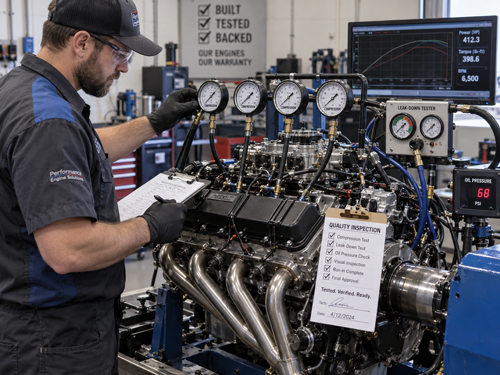
For most replacement scenarios, a remanufactured or tested used engine delivers the best balance of cost and reliability — provided the supplier backs it with a documented testing process and a real warranty. A complete engine assembly from a qualified source should arrive with compression-test results, a leak-down report, and confirmation that every sensor and accessory is present and functional.
How Fuchuan Engine Simplifies Engine Selection
The entire engine matching process becomes far easier when you work with a supplier that has done the cataloging work for you. Fuchuan Engine, based in Guangzhou, China, has supplied engine assemblies, cylinder heads, and cylinder blocks to global buyers for more than a decade. Every engine in the catalog is identified by its exact code and OE number, so a buyer who provides a VIN or engine code receives a precise match rather than a generic suggestion.
For buyers who need a complete drop-in solution, Fuchuan's auto engine assemblies cover a wide range of passenger and light-commercial applications. When a repair involves only the top end, matching cylinder heads and cylinder blocks are cataloged separately for precision. Turbocharged applications are supported through dedicated turbocharger replacement options, and buyers with a proprietary specification can engage Fuchuan's OEM/ODM service to develop or customize an engine to exact requirements.
Every unit is 100% tested before dispatch and covered by a 12-month warranty, which removes much of the risk that otherwise accompanies long-distance engine purchases. For businesses looking to build a recurring supply line, Fuchuan's global agent program offers regional distribution rights, price support, and technical training.
A Practical Checklist for Your Next Engine Order
Before you submit any engine order, run through this checklist:
- Record the exact make, model, generation, year, and region of the vehicle.
- Capture the VIN and decode it to confirm the engine family.
- Locate and photograph the engine code stamped on the block or plate.
- Note the displacement, fuel type, and transmission type.
- Identify the OE part number if available.
- Confirm the assembly level you need: short block, long block, or complete engine.
- Match your specification against the supplier's catalog by code, not by model name.
- Verify the supplier's testing process and warranty terms before paying.
Following these steps turns engine selection from a gamble into a routine. The buyers who succeed are not those with the most experience, but those who insist on exact identification and a documented match every time.
Final Thoughts
A correct engine match is the foundation of a successful purchase. Whether you are sourcing a single unit for a customer's car or building a distributor inventory that spans dozens of models, the discipline of exact identification — engine code, OE number, displacement, fuel type, and transmission — is what protects your investment. Pair that discipline with a supplier that catalogs by code, tests every unit, and stands behind a 12-month warranty, and engine selection becomes one of the most predictable parts of your business.
To begin matching your next engine, browse the complete inventory at Fuchuan Engine or reach out with your VIN or engine code for a precise, no-obligation quotation. If you are interested in building a long-term supply relationship, explore the global agent program and take the first step toward a partnership built on accurate matching and dependable quality.
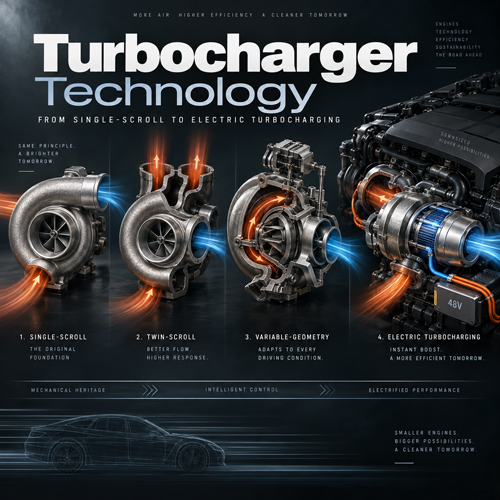
Turbocharger Technology: From Single-Scroll to Electric Turbocharging
Related Article