Engine Purchasing FAQ: MOQ, Lead Time, and Payment Terms Explained
Every engine buyer walks into a sourcing conversation with the same handful of questions, and the most important one is usually the first: what is the minimum order quantity, and can the supplier work with a buyer who is just starting out? Close behind come questions about engine shipping time, engine payment terms, warranty, sample orders, and what happens after the sale. These are not trivial details—they determine cash flow, inventory risk, and whether a first order ever becomes a long-term partnership. This guide answers the ten questions Fuchuan Engine hears most often from importers, distributors, and workshops around the world, so you can evaluate the terms of an engine order before you commit a single dollar. Where a specific number depends on model or destination, we state the principle and the range so the answer stays honest and useful.
1. What Is Your Engine MOQ?
The engine MOQ—minimum order quantity—is the first thing most buyers ask, and for good reason. It determines whether a new distributor can test the water or must commit to a container before knowing whether the market will respond.
Fuchuan Engine's MOQ policy is built around a simple principle: entry should be accessible, and scale should be rewarded. For stock engine assemblies, the MOQ is deliberately low, allowing a buyer to place a first order of a single unit to verify quality, packaging, and documentation before committing to volume. For mixed orders across models, MOQ applies to the total rather than to each SKU, so a buyer can consolidate several different engines and components into one shipment. For custom OEM/ODM builds, the MOQ is set per project, because tooling, calibration, and engineering time are amortized across the run.
The practical advice is to ask not only for the number but for what happens above and below it. A supplier whose MOQ drops as volume rises—or who can structure a trial order without penalty—is signaling that they are interested in a relationship, not a single transaction.
2. Can I Order a Sample Before Committing to Bulk?
Yes, and in most cases a first small order functions as the sample. Because stock engines are tested and documented before shipping, a buyer can use a one- or two-unit order to evaluate build quality, crate packaging, and the completeness of the export documentation without taking on a full container. This is the most common way new distributors begin, and it is why the stock MOQ is kept low.
For a buyer who needs a unit before any commercial order at all—for example, to validate a fitment or to show a prospective customer—discuss the requirement directly with the account manager. The goal is always the same: let the buyer verify the product, the process, and the paperwork with minimal upfront exposure.
3. How Long Is Your Engine Shipping Time?
Engine shipping time is a function of two things: whether the engine is in stock, and how it travels. The two are worth separating, because they are controlled differently.
For an in-stock engine, production time is effectively zero—the unit already exists and has passed its testing. The variable is transportation. Air freight can deliver a single engine to a major international hub in a matter of days, at a cost premium that makes sense for urgent repairs or trial orders. Sea freight is the economical default for volume, with transit typically measured in weeks depending on origin-to-destination routing, customs clearance, and port congestion. The honest answer to "how long?" is therefore a range, not a single number, and it should be quoted per order with the destination port known.
For custom or OEM/ODM engines, add the production window on top of transit: engineering confirmation, sourcing of the specific block and cylinder head, machining, assembly, and the full testing sequence. A reputable supplier will give you a build schedule with milestones rather than a vague promise, and will tell you up front which stages are fixed and which can be compressed.
The key discipline for buyers is to separate production time from transit time and to confirm both in writing. A supplier who conflates them is not being dishonest—but you need the split to plan your own inventory and customer commitments.
Tied to shipping time is the question of Incoterms, which define who pays for and arranges each leg of the journey. Under EXW (Ex Works), the buyer collects from the factory gate and owns everything downstream; under FOB (Free On Board), the seller delivers to the port of origin; under CIF (Cost, Insurance, and Freight), the seller covers freight and insurance to the destination port. Each shifts cost and control between buyer and seller. New importers often default to CIF for simplicity, while established distributors frequently prefer FOB so they can use their own forwarder and rates. Ask which Incoterm a quote assumes—two identical prices can mean very different things once freight and insurance are counted, and the split between production and transit time will look different under each.
4. What Are Your Engine Payment Terms?
Engine payment terms are where trust and cash flow meet, and the structure usually follows the size and maturity of the relationship.
For first orders and sample orders, the standard is a deposit against the order with the balance due before shipment—commonly expressed as a percentage split such as 30/70 via bank transfer (T/T). This protects the supplier from producing goods that are never collected while limiting the buyer's exposure until the units are ready. For established distributors with a track record, more flexible terms are available, including letters of credit (L/C) for larger programs and negotiated credit on repeat volume.
A few points are worth asking about explicitly. Confirm the exact payment milestones—when the deposit is due, when the balance is due, and what triggers the final payment. Ask whether the price is quoted in USD or another currency and who bears the transfer and bank fees. And confirm the documents you will receive with payment, because the export paperwork is part of what you are buying. Clear, written terms are a sign of a professional supplier; ambiguity on payment is a reason to slow down, not speed up.
Currency is a detail that deserves its own line. Cross-border engine trade is overwhelmingly priced in US dollars, which is convenient but not neutral—exchange-rate movement between your local currency and the dollar can shift your landed cost between the moment you place the order and the moment you pay the balance. Some buyers manage this by paying a larger deposit to lock in more of the cost early, while others prefer to agree on a fixed USD price and accept the currency risk as part of their own planning. Either way, the price, the currency, and the fee responsibilities should all be written down in the proforma invoice, so that both sides are pricing the same transaction.
5. What Warranty Do You Provide?
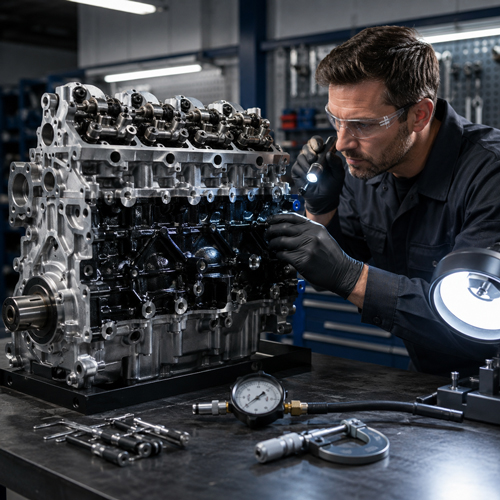
Every Fuchuan engine—new, remanufactured, or custom—is backed by a 12-month warranty covering manufacturing and material defects, and it is supported by a documented testing program: 100% cold testing, dynamic balancing, leak and seal verification, and hot testing on sampled and high-performance builds. The warranty is a guarantee of workmanship, not a promise that covers misuse, improper installation, or neglect of external systems. Ask for the written warranty terms alongside any quote, and ask for the test documentation that sits behind them—a supplier who can show you a cold-test log is a supplier who measures its work rather than merely describing it.
6. How Are Engines Packaged and Protected for Export?
Export packaging is easy to overlook and expensive to get wrong. An engine that arrives corroded or damaged negates every advantage of the sourcing decision. Fuchuan packs engines for ocean transit with vapor-phase corrosion inhibitors (VCI), proper moisture barriers, and engineered crating or reinforced cartons rated for the journey, including ISPM 15 heat-treated wood where required. Confirm packaging before shipping, and if the destination is humid or the transit long, say so—packaging can be upgraded to match the route.
7. Do You Provide Test Reports and Export Documentation?
Yes. A professional engine order includes more than a crate. Expect, and request, the test report for the unit, the packing list, the commercial invoice, and any certificates required for customs in the destination country. For remanufactured engines, the documentation should also make the remanufacturing process and testing transparent, because that is what lets the buyer represent the product honestly to their own customers. Documentation that can be tied to a specific serial number is the strongest proof a supplier can offer.
8. What Is Your After-Sales Process?
After-sales is where weak suppliers reveal themselves, because it only shows up after the money has changed hands. The process should be defined before the order, not discovered during a problem. In practice, that means a single point of contact for claims, a defined procedure for documenting a defect (photos, serial number, fault description), and a stated resolution path—repair, replacement, or credit—within the warranty window. A supplier who can describe their after-sales process in one clear paragraph before you buy is more trustworthy than one who promises "no problem" and then vanishes.
9. Can You Support Custom or OEM/ODM Requirements?
If your market needs a specific configuration—a particular compression ratio, a different turbo, a calibration for local fuel quality—the question is whether the supplier can engineer it or only resell it. Fuchuan's OEM/ODM service covers the full path from requirement through design, prototyping, testing, and volume production, including the cylinder block, cylinder head, and turbocharger selection that a given application demands. If your requirements are custom, raise them early—customization is far cheaper when it is designed in from the start than when it is retrofitted after the fact.
10. Do You Offer Agent or Distributor Partnerships?
For buyers who want to move beyond one-off purchasing and build a regional business, Fuchuan runs a global agent program offering authorized status, pricing support, technical training, and regional coordination. The economics of a partnership are different from the economics of a purchase: you are not just buying engines, you are licensing a supply relationship, and the terms should reflect that. Ask about exclusivity, pricing structure, minimum commitments, and what marketing and technical support is included before you sign.
The Buyer's FAQ at a Glance
| # | Question | Short Answer |
|---|---|---|
| 1 | What is your engine MOQ? | Low for stock; mixed orders count in total; custom set per project |
| 2 | Can I order a sample? | Yes—a small first order serves as the sample |
| 3 | How long is shipping time? | In-stock: days (air) to weeks (sea); custom adds a build window |
| 4 | What are payment terms? | Deposit + balance before shipment (T/T); L/C and terms for established buyers |
| 5 | What warranty do you offer? | 12-month warranty on manufacturing and material defects |
| 6 | How are engines packed? | VCI protection, moisture barrier, engineered ISPM 15 crating |
| 7 | Do you provide reports? | Yes—test report, packing list, invoice, customs certificates |
| 8 | After-sales process? | Single contact, defined claim path, fast resolution within warranty |
| 9 | Can you do OEM/ODM? | Yes—full custom engineering to volume production |
| 10 | Agent partnerships? | Yes—authorized distributor program with training and support |
Turn the Answers Into an Order
The difference between a good engine supplier and a risky one rarely shows up in the product catalog. It shows up in the answers to these ten questions: whether the MOQ lets you start small, whether the shipping time is split honestly between production and transit, whether the payment terms are written down, and whether the warranty and after-sales process are defined before you ever need them.
Fuchuan Engine has spent more than a decade answering exactly these questions for buyers across 800+ vehicle applications, and the answers are built into how the company operates—not improvised at the sales stage. If you are ready to move from questions to an order, contact us for a quote, a testing report, and clear terms in writing. Your next engine program starts with the answers on this page.
Nissan VQ Series V6: How a Naturally Aspirated Engine Dominated Ward's 10 Best for 14 Straight Years
Toyota GR vs BMW B58: A Technical Deep-Dive into Two Modern Six-Cylinder Engine Families
Related Article