Toyota GR vs BMW B58: A Technical Deep-Dive into Two Modern Six-Cylinder Engine Families
When procurement managers and engine distributors evaluate six-cylinder powertrains for their inventory, two families consistently dominate the conversation: the Toyota GR engine family and the BMW B58 engine. Both represent the pinnacle of their respective manufacturers' six-cylinder engineering, yet they approach performance, reliability, and architecture from fundamentally different directions. The Toyota GR family—spanning decades of naturally aspirated V6 development—powers everything from rugged off-road SUVs to refined luxury sedans, while the BMW B58 has redefined what a turbocharged inline-six can deliver in the modern era. This comprehensive comparison examines their cylinder block design, forced induction strategies, thermal management systems, valvetrain technologies, and real-world sourcing implications. Whether you are stocking inventory for a distribution network or evaluating replacement options for a high-mileage fleet, understanding these two engine families is essential to making informed procurement decisions.
The Architecture Divide: V6 vs Inline-Six
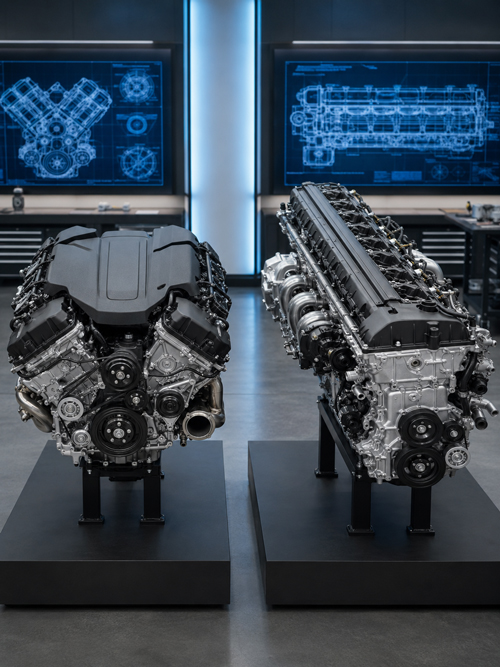
Before dissecting the internals, it is worth addressing the most obvious design difference: the Toyota GR series uses a 60-degree V6 layout, while the BMW B58 employs a traditional inline-six configuration. This is not merely an aesthetic distinction—it fundamentally shapes every aspect of engine behavior.
An inline-six is inherently balanced. With crankshaft throws spaced 120 degrees apart, the primary and secondary forces cancel perfectly without requiring balance shafts. The result is the signature silky-smooth power delivery that BMW inline-six engines have been celebrated for since the M20 era. The B58 inherits this natural refinement and pairs it with modern forced induction, producing an engine that pulls linearly from idle to its 7,000 rpm redline with almost turbine-like smoothness.
The V6, by contrast, trades that natural balance for packaging efficiency. A 60-degree V6 is shorter and wider than an inline-six, making it far easier to fit transversely in front-wheel-drive platforms like the Toyota Camry and Highlander. The 1GR-FE—a 4.0L V6—would be impossibly long as an inline configuration, yet slots neatly into the engine bay of a Toyota 4Runner or FJ Cruiser. Toyota compensates for the inherent V6 imbalance through careful crankshaft counterweighting and, in later 2GR variants, dual variable valve timing that smooths out combustion pulses across the rev range.
Neither layout is objectively superior. The inline-six wins on refinement; the V6 wins on packaging versatility. The critical question for buyers is which trade-off matters more for their target application.
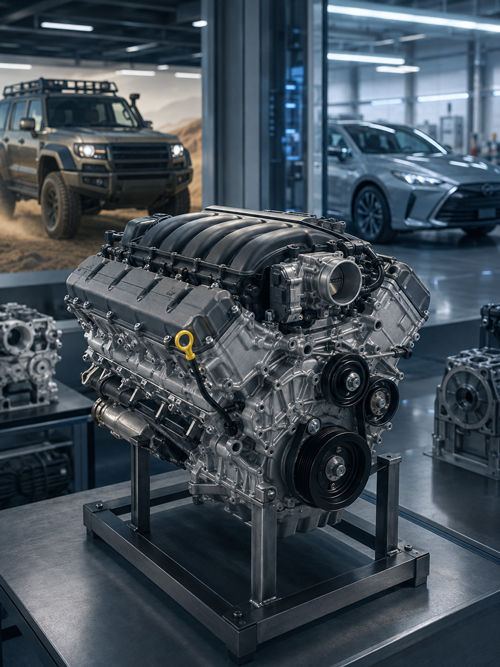
Toyota GR Family: Two Decades of N/A V6 Evolution
The GR engine family debuted in 2002, replacing both the MZ V6 and the legendary JZ inline-six as Toyota's universal six-cylinder platform. Over two decades, it has powered more than 30 Toyota and Lexus models globally, earning a reputation for near-legendary durability.
1GR-FE: The Off-Road Workhorse
The 1GR-FE is a 4.0-liter V6 with a 94 mm bore and 95 mm stroke, yielding 3,956 cc of displacement. Its architecture reflects Toyota's priorities for truck and SUV applications: a cast-iron cylinder liner pressed into an aluminum block, a conservative 10.0:1 compression ratio, and single VVT-i on the intake camshaft only. Output ranges from 236 to 272 horsepower depending on market and fuel grade, with torque peaking between 266 and 278 lb-ft.
What makes the 1GR-FE remarkable is not its power figures—modest by modern standards—but its thermal management design. Toyota engineered water passages between adjacent cylinders on each bank, a feature uncommon in V6 engines of this era. These inter-bore cooling channels reduce hot-spotting and maintain uniform combustion chamber temperatures under sustained load, which is critical when a fully loaded Land Cruiser Prado is crawling through desert terrain at low speed with minimal airflow. The block also uses a taper-squish combustion chamber with matching piston crowns to suppress knock, allowing the engine to run reliably on 87-octane fuel in markets where premium fuel is unavailable or prohibitively expensive.
The 1GR-FE's siamese intake port design—where adjacent intake runners share a common wall—reduces port surface area and minimizes fuel adhesion to the walls during cold starts. Combined with Toyota's high-temperature plastic insulator filling the open-deck void, these features make the 1GR one of the most abuse-tolerant V6 engines ever produced. It is common to see 1GR-powered vehicles crossing 300,000 miles with only routine maintenance.
2GR-FE and 2GR-FKS: Efficiency Meets Versatility
Where the 1GR prioritizes ruggedness, the 2GR-FE targets refinement and efficiency. Displacing 3.5 liters (94 mm bore, 83 mm stroke), the 2GR-FE introduced Dual VVT-i—variable valve timing on both intake and exhaust camshafts—along with roller-follower rocker arms that reduce valvetrain friction. The compression ratio rises to 10.8:1, and output jumps to 268–295 horsepower on regular fuel.
The 2GR-FKS variant, introduced later, adds Toyota's D-4S fuel system: a combination of direct injection and port injection that switches seamlessly depending on load. Under light cruise, port injection keeps the intake valves clean; under acceleration, direct injection cools the combustion chamber and enables the engine to operate at a 11.8:1 compression ratio on the 2GR-FSE performance variant. This dual-injection strategy gives the 2GR series a rare combination of carbon-buildup resistance (a known Achilles' heel of direct-injection-only engines) and high specific output.
The 2GR-FE earned its reputation by being everywhere. Powering the Camry, Avalon, RAV4, Highlander, Sienna, Lexus ES 350, and Lexus RX 350 simultaneously, it became the single most widely deployed Toyota V6 of the 21st century. For engine distributors, this breadth of application translates directly into demand: an engine assembly from the 2GR family services vehicles across five distinct market segments.
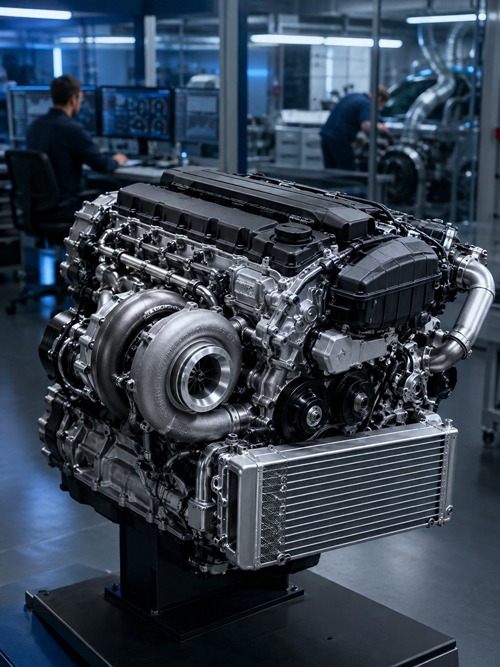
BMW B58: The Turbocharged Inline-Six Benchmark
The BMW B58 debuted in 2015 as the successor to the N55, and it did not merely iterate—it fundamentally re-architected the modern turbo inline-six. It has since earned five Ward's 10 Best Engines awards and powers vehicles from the entry-level 2 Series to the flagship X7 SUV, as well as the Toyota GR Supra (A90) under BMW-Toyota collaboration.
Closed-Deck Block and Forged Internals
The B58's most consequential design decision is its closed-deck aluminum block. Unlike the open-deck design common in production engines (including the Toyota GR series), a closed deck means the cylinder bores are fully supported at the top by continuous deck material connecting to the outer block walls. This dramatically increases cylinder rigidity under high boost pressure—the B58 runs 12–17 psi of boost in stock form, and aftermarket tuners routinely push past 25 psi without block distortion.
Adding to the strength equation: a forged steel crankshaft and forged connecting rods are standard, not optional. The cylinder walls use a plasma arc wire spray coating (LDS—Lichtbogendrahtspritzen) instead of traditional cast-iron liners. This iron-based coating is only 0.3 mm thick, reducing weight while improving heat transfer from the combustion chamber to the coolant. The bore measures 82 mm with a 94.6 mm stroke, yielding a square 2,998 cc displacement.
The B58TU (Technical Update) revision in 2018 further refined the block: crankshaft weight was reduced, main bearing diameters were trimmed, and the timing chain moved from a two-piece to a single-piece design for improved long-term durability. Injection pressure increased from 200 to 350 bar, and a gasoline particulate filter was integrated into the exhaust for Euro 6d compliance.
Twin-Scroll Turbo and Integrated Thermal Management
The B58's single turbocharger uses a twin-scroll turbine housing, with exhaust pulses from cylinders 1-2-3 and 4-5-6 routed through separate scrolls. This eliminates exhaust pulse interference between cylinders that fire 240 degrees apart, effectively mimicking the response of a twin-turbo system in a single, lighter package. The result is peak torque—up to 500 Nm (369 lb-ft)—available from as low as 1,380 rpm, with a flat plateau extending to 5,000 rpm.
BMW engineers made an unusual choice by integrating the water-to-air intercooler directly into the intake manifold. This eliminates the long charge piping typical of front-mount air-to-air intercoolers, slashing the intake tract volume and dramatically reducing throttle lag. The closed-circuit cooling system uses a dedicated low-temperature radiator and electric water pump, maintaining intake air temperatures within a narrow band regardless of ambient conditions.
The B58 also features a split cooling circuit: the cylinder head and crankcase operate on independent coolant loops with separate thermostats. The head runs cooler for knock resistance; the block runs warmer to reduce friction and oil viscosity. An engine-mounted heat encapsulation shell retains warmth after shutdown, cutting cold-start wear and bringing the catalytic converter to operating temperature faster.
Head-to-Head Technical Comparison
| Specification | Toyota 1GR-FE (4.0 V6) | Toyota 2GR-FE (3.5 V6) | BMW B58B30M0 (3.0 I6) |
|---|---|---|---|
| Configuration | 60° V6 | 60° V6 | Inline-6 |
| Displacement | 3,956 cc | 3,456 cc | 2,998 cc |
| Bore × Stroke | 94 × 95 mm | 94 × 83 mm | 82 × 94.6 mm |
| Block Material | Aluminum + Iron Liners | Aluminum + Iron Liners | Aluminum (Closed-Deck, LDS Coating) |
| Compression Ratio | 10.0:1 | 10.8:1 | 11.0:1 |
| Aspiration | Naturally Aspirated | Naturally Aspirated | Twin-Scroll Turbo |
| Valvetrain | DOHC 24V, Single VVT-i | DOHC 24V, Dual VVT-i | DOHC 24V, Double VANOS + Valvetronic |
| Fuel System | Multi-Port Injection | Multi-Port Injection (FKS: D-4S) | Direct Injection (350 bar) |
| Max Power | 236–272 hp | 268–311 hp | 322–382 hp |
| Max Torque | 266–278 lb-ft | 248–280 lb-ft | 332–369 lb-ft |
| Redline | 5,600 rpm | 6,400 rpm | 7,000 rpm |
| Production Years | 2002–present | 2005–present | 2015–present |
| Key Applications | 4Runner, Tacoma, FJ Cruiser, Prado | Camry, Highlander, Avalon, ES 350, RX 350 | 340i, 440i, 540i, X5, M240i, Supra (A90) |
The numbers tell a clear story. Toyota's GR engines prioritize displacement, simplicity, and broad torque delivery from natural aspiration—attributes that translate into exceptional longevity. The BMW B58 achieves higher specific output (107–127 hp per liter vs. 59–68 for the 1GR and 77–88 for the 2GR) through forced induction and more aggressive tuning, at the cost of greater mechanical complexity.
Performance Philosophy: Reliability vs. Specific Output
The philosophical divergence between these families becomes clearest when examining parts count and failure modes.
The Toyota GR's naturally aspirated design means fewer components that can fail. There is no turbocharger to coke up, no intercooler pump to seize, no wastegate actuator to stick, and no high-pressure fuel pump to wear out. The cylinder head uses traditional shim-under-bucket lifters that require adjustment every 60,000–100,000 miles but almost never fail catastrophically. The multi-port injection system continuously washes the intake valves with fuel, eliminating carbon buildup as a concern.
The trade-off is specific output. The 1GR-FE produces roughly 60 horsepower per liter—adequate for truck and SUV duty but unremarkable by performance standards. The 2GR-FKS pushes to approximately 88 hp/L with its D-4S system, closing the gap somewhat.
The B58, by contrast, extracts over 120 hp/L from a smaller displacement through aggressive turbocharging. The turbocharger is central to this achievement—a BorgWarner twin-scroll unit that spools quickly and sustains boost across a wide RPM band. However, turbocharging introduces thermal stress. Exhaust gas temperatures regularly exceed 950°C at full load, and the integrated exhaust manifold (cast into the cylinder head on B58TU models) must manage extreme heat cycling. BMW addresses this through the split cooling circuit, but the long-term durability of turbocharged components at high mileage remains an area where the naturally aspirated GR engines hold a measurable advantage.
On the valvetrain side, BMW's Valvetronic system—which varies valve lift continuously from 0.3 mm to 9.9 mm—eliminates the throttle plate as the primary airflow regulator, reducing pumping losses and improving part-throttle efficiency. Toyota's Dual VVT-i adjusts only timing, not lift, but it does so with fewer moving parts. For a fleet operator calculating total cost of ownership across a 200,000-mile lifecycle, the Toyota approach often pencils out lower.
Maintenance and Parts Availability
This is where the comparison shifts from engineering to economics, and where sourcing decisions are made.
Toyota GR parts availability is exceptional. The 1GR-FE and 2GR-FE have been in production for over 20 years with minimal design changes. Aftermarket support spans every continent, and even OEM components are competitively priced. This extends to cylinder blocks and complete long-block assemblies. A replacement 1GR-FE short block can be sourced for a fraction of the cost of a comparable BMW unit, and the simpler engine architecture means fewer specialized tools are required for installation.
BMW B58 parts are more expensive and, in some regions, less readily available. The closed-deck block cannot be bored oversize—if cylinder wall damage occurs, the block must be replaced entirely. The direct injection system operates at extreme pressures (350 bar in B58TU), and the high-pressure fuel pump is a known wear item beyond 80,000–100,000 miles. However, the B58's modular design (sharing architecture with the B38 three-cylinder and B48 four-cylinder) means that certain ancillary components—water pumps, alternators, sensors—benefit from economies of scale across BMW's entire product range.
For buyers sourcing these engines through OEM/ODM channels, lead times differ significantly. Toyota GR engines, particularly the high-volume 2GR-FE, are typically available from stock in major markets. B58 engines, especially the O1 high-output variant, may require 4–8 weeks due to higher demand and tighter supply from BMW's own production allocation.
Which Engine Should You Stock?
The answer depends entirely on your customer base:
Choose Toyota GR engines if your market is: - Fleet and commercial vehicle operators who prioritize uptime and TCO - Off-road and utility vehicle owners in regions with variable fuel quality - Budget-conscious buyers who need a reliable replacement engine assembly with predictable maintenance costs - Distributors serving developing markets where turbocharged engine expertise is limited
Choose BMW B58 engines if your market is: - Performance-oriented workshops and tuning shops - European vehicle specialists who understand BMW diagnostic procedures - Buyers prioritizing power density and driving refinement - Markets with access to premium fuel and qualified BMW technicians
The reality for most engine distributors is that both families belong in inventory. A well-stocked supplier should maintain cylinder block coverage for 1GR-FE/2GR-FE applications while carrying B58 long blocks for the growing population of F30/G20 3 Series, G05 X5, and A90 Supra vehicles entering the replacement market.
Sourcing Both Families from One Partner
Managing separate supply chains for Japanese and European engine platforms adds operational complexity. This is where a comprehensive engine supplier with multi-brand coverage becomes valuable. Fuchuan Engine maintains inventory across both the Toyota GR and BMW B58 families, with each unit undergoing a full testing protocol before shipment:
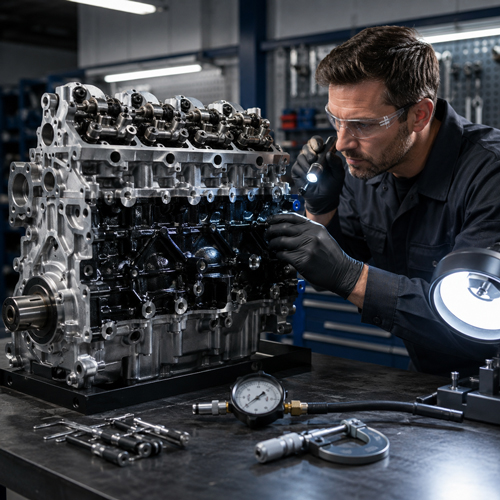
- Cold compression test—verifies cylinder sealing and ring condition across all cylinders
- Cylinder bore inspection—confirms wall integrity, particularly critical for B58's LDS-coated bores and 1GR's thin iron liners
- Bearing clearance measurement—ensures main and rod bearing tolerances meet factory specifications
- Dynamic balance verification—validates rotating assembly balance, reducing long-term vibration-related wear
Every engine ships with a 12-month warranty and VCI (Volatile Corrosion Inhibitor) packaging rated for ocean freight, ensuring the unit arrives in ready-to-install condition whether it is destined for a workshop in Dubai or a distributor in Lagos.
Conclusion
The Toyota GR and BMW B58 engine families represent two divergent philosophies that both achieve excellence on their own terms. The GR V6 prioritizes durability, simplicity, and multi-platform versatility—an engine family designed to outlast the vehicles it powers. The B58 inline-six prioritizes specific output, thermal efficiency, and driving refinement—a masterclass in extracting performance from a turbocharged platform without sacrificing the intrinsic smoothness that defines a straight-six.
Neither approach is wrong. The right question is not "which engine is better" but "which engine is better for your customers."
For procurement teams seeking reliable supply of tested engines across both families, Fuchuan Engine offers 800+ model coverage with 10+ years of export experience to over 40 countries. Whether you need a 1GR-FE for a fleet of Land Cruiser Prados or a B58 long block for a performance shop's next build, our QA-tested inventory and 12-month warranty provide the confidence to buy from China with peace of mind.
Interested in establishing a long-term supply partnership? Learn more about our global agent program — regional exclusivity, pricing support, and technical training are available for qualified distributors.
Engine Purchasing FAQ: MOQ, Lead Time, and Payment Terms Explained
How to Identify a Quality Remanufactured Engine: 5 Critical Inspection Points
Related Article