Nissan VQ Series V6: How a Naturally Aspirated Engine Dominated Ward's 10 Best for 14 Straight Years
Ask any automotive enthusiast to name the greatest V6 engines ever built, and the Nissan VQ engine family is almost always near the top of the list. Produced continuously from 1994 through 2017, the VQ series is the most decorated engine family in the history of Ward's 10 Best Engines, winning a spot on the list for 14 consecutive years between 1995 and 2008. That is a record no other engine—turbocharged, hybrid, or otherwise—has matched. But the VQ was never about headline power figures or exotic materials. It won its reputation the hard way: through obsessive attention to friction reduction, balance, and manufacturing precision, qualities that made it feel more refined than engines costing twice as much. For global buyers in the automotive aftermarket, the VQ also remains one of the most sought-after engine assemblies on the second-hand and remanufactured market, prized for its tunability, cross-platform compatibility, and genuinely bulletproof bottom end.
This guide traces the VQ from its debut to its final evolution, explains the specific engineering decisions that produced its legendary smoothness, and shows what a buyer should look for when sourcing a Nissan VQ engine today.
The Origins of the VQ Series
The VQ story begins in 1994, when Nissan introduced the VQ30DE as the successor to the aging VG-series V6. The VG had served the company well since the early 1980s, but it was a cast-iron-block design rooted in an earlier era, and by the early 1990s it could no longer hide its age in an industry racing toward lighter, smoother, more efficient engines. Nissan's brief for the VQ was ambitious for its time: build a V6 engine that would set a new benchmark for refinement, quietness, and specific output, while remaining compact enough to fit everything from a front-wheel-drive family sedan to a rear-wheel-drive sports coupe.
The result was the 3.0-liter VQ30DE, which debuted in the 1995 Nissan Maxima. From its very first year, it impressed the automotive press for a quality that is hard to put on a spec sheet: a sense of silkiness and absence of vibration that made it feel like a far more expensive engine. Ward's Auto World noticed immediately, naming the VQ30DE to its 10 Best Engines list in 1995—the first of what would become an unbroken 14-year streak.
The Engineering That Made the VQ Special
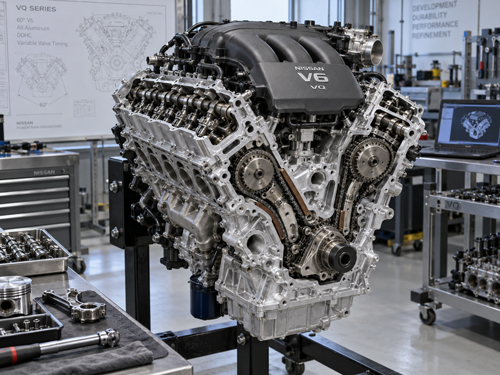
The VQ's reputation was not an accident. It was the product of a handful of deliberate engineering choices, each of which compounded to produce an engine that felt smoother, revved harder, and lasted longer than its rivals.
The 60-Degree V6 Layout
Every production VQ used a 60-degree bank angle between its cylinder rows. This was not an arbitrary number. A 60-degree V6 has inherently even firing intervals and excellent primary balance, which means less vibration to cancel out with counterweights and balancer shafts. The result is an engine that spins smoothly from idle to redline without the coarse secondary shake that plagued many 90-degree V6 designs of the era. For buyers, that balance translates directly into long service life, because a smoother engine places less cyclical stress on its main bearings, crankshaft, and mounting points.
All-Aluminum Construction
The VQ was built around an all-aluminum cylinder block and cylinder head, a significant departure from the cast-iron VG it replaced. Aluminum cut mass from the nose of the vehicle, improving weight distribution and handling, but it also posed a thermal-management challenge that Nissan addressed with careful cooling-jacket design. The payoff was an engine that warmed up quickly, shed heat efficiently, and resisted the detonation that limits specific output in cast-iron designs. This all-aluminum architecture is exactly the kind of quality that still matters on the replacement market, where the integrity of a cylinder block and cylinder head determines whether a used engine is worth rebuilding or only good for scrap.
Friction Reduction: Mirror Finish and DLC Coatings
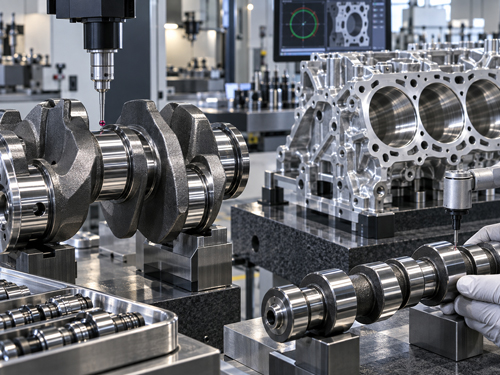
The most famous—and least visible—part of the VQ formula was its war on friction. Nissan finished the crankshaft and camshaft journals with a mirror-like micro-polish, reducing surface roughness so dramatically that frictional losses in the rotating assembly dropped by roughly 30 percent compared with conventional finishing. The valve lifters received a diamond-like carbon (DLC) coating, which cut friction at the cam-to-follower interface by as much as 40 percent. Combined with oil jets that sprayed a fine mist of oil directly onto the cylinder walls, these measures meant the VQ converted a larger share of its combustion energy into useful motion—and wore its internal components far more slowly in the process.
Near-Square Bore and Stroke
From the VQ35DE onward, the engine used a bore of 95.5 mm and a stroke of 86.0 mm, a near-square ratio that is one of the signatures of a high-revving, free-breathing V6. The oversquare layout—where the bore exceeds the stroke—lets the engine use larger valves and pull cleanly to high rpm without excessive piston speed. It is one of the reasons a VQ35DE can hold its own in a tuner build where the redline keeps climbing, and why the VQ37VHR was able to push its rev limit to 7,600 rpm while still producing usable low-end torque.
Fourteen Consecutive Years of Ward's 10 Best
The Ward's 10 Best Engines list, published annually by Ward's Auto World, evaluates engines not on raw horsepower alone but on a blend of performance, refinement, technology, and real-world drivability. No engine family has ever been more successful in that arena than the VQ.
| Year | Engine | Notable Application |
|---|---|---|
| 1995–2001 | VQ30DE (3.0L) | Nissan Maxima, Infiniti I30 |
| 2002–2006 | VQ35DE (3.5L) | Nissan 350Z, Altima, Infiniti G35 |
| 2007 | VQ35HR (3.5L) | Nissan 350Z, Infiniti G35 |
| 2008 | VQ37VHR (3.7L) | Nissan 370Z, Infiniti G37 |
The streak is remarkable for its length, but what makes it genuinely significant is that the VQ won across three distinct generations. The VQ30DE earned the award through its refinement; the VQ35DE through its combination of everyday tractability and tuner-friendly strength; and the VQ37VHR through its variable valve event and lift technology, which Ward's credited for its blend of power and efficiency. After 2008 the family's streak ended, though the VQ returned to the list twice more—in 2012 as a hybrid application and in 2016 as the VQ35DE—bringing its lifetime total to 16 appearances, more than any other engine family in history.
The VQ Family, Generation by Generation
Understanding the VQ means understanding how it evolved from a refined cruiser's engine into a high-revving enthusiast favorite without ever abandoning its core character.
VQ30DE (1994–2001): The Benchmark Setter
The 3.0-liter VQ30DE established the template. With DOHC four-valve heads, sequential multi-point fuel injection, and Nissan's attention to friction reduction, it delivered around 190 to 222 horsepower depending on application and tuning. More important than the number was the way it delivered it: smooth, quiet, and eager. The VQ30DE also spawned a high-performance derivative, the VQ30DETT, a twin-turbocharged version that powered the Nissan Skyline GT-R's lesser-known siblings and demonstrated early on how well the VQ's bottom end responded to forced induction.
VQ35DE (2001–2008): The Workhorse
The VQ35DE took the VQ to 3.5 liters and became the family's most versatile member. It is best known for powering the Nissan 350Z and the Infiniti G35, where it produced roughly 287 horsepower, but it also appeared in everything from the Nissan Altima and Maxima to the Murano SUV and Pathfinder. This cross-platform flexibility is exactly why it remains such a common sight in the aftermarket: a single well-supported V6 engine that fits sports cars, sedans, and SUVs alike is a distributor's dream.
VQ35HR (2007): The High-Revolution Step
The VQ35HR (for "High Response and High Revolution") was a substantial rework rather than a mild refresh. It gained a taller block, a raised 7,500 rpm redline, dual throttle bodies, and a stronger bottom end, lifting output to roughly 306 horsepower. The HR addressed the VQ35DE's tendency to run out of breath at the top of the tachometer, and it proved that the VQ platform could be pushed hard without sacrificing reliability.
VQ37VHR (2008–2020): The Final Form
The VQ37VHR is the ultimate expression of the naturally aspirated VQ. Displacing 3.7 liters, it introduced VVEL (Variable Valve Event and Lift), Nissan's continuously variable valve-lift system that adjusts how far the intake valves open in real time. The result was an engine that produced around 330 horsepower at 7,000 rpm—and up to 350 in Nismo-tuned Nissan 370Z trim—while maintaining a broad, linear torque curve and a 7,600 rpm redline. VVEL removed the traditional compromise between low-end torque and high-rpm power, letting the engine feel strong everywhere. It is the VQ in its most complete form, and it closed out the family's Ward's 10 Best streak in 2008.
| Specification | VQ30DE | VQ35DE | VQ35HR | VQ37VHR |
|---|---|---|---|---|
| Displacement | 3.0 L | 3.5 L | 3.5 L | 3.7 L |
| Valvetrain | DOHC 24v | DOHC 24v | DOHC 24v | DOHC 24v + VVEL |
| Peak power | ~190–222 hp | ~287 hp | ~306 hp | ~330–350 hp |
| Redline | ~6,600 rpm | ~7,000 rpm | 7,500 rpm | 7,600 rpm |
| Compression ratio | ~10.0:1 | 10.3:1 | 10.6:1 | 11.0:1 |
Naturally Aspirated vs Turbocharged: Why the VQ Still Matters
In an era when nearly every manufacturer has replaced its naturally aspirated V6 with a downsized turbocharged four or a force-fed V6, the VQ stands out as one of the last great examples of the old school done right. There is a reason enthusiasts still seek it out: a large, naturally aspirated V6 engine delivers throttle response and linear power delivery that a turbocharged engine struggles to match, along with a distinctive, high-revving character that modern turbo mills have largely traded away for efficiency.
That said, the VQ has never been afraid of a turbocharger. The VQ30DETT proved early on that the platform's strong bottom end could handle boost, and the aftermarket has since taken VQ35DE and VQ37VHR builds well past 500 horsepower with forced induction. This dual nature—rewarding in stock naturally aspirated form, yet robust enough for serious modification—is a large part of what keeps demand for these engines alive. For a buyer weighing a replacement, the calculus is simple: a well-maintained VQ offers a proven, tunable platform without the added complexity and heat load of an OEM turbo system, while a properly specified turbocharger remains a viable upgrade path for those who want more.
Real-World Reliability and Known Weak Points
The VQ's longevity is not theoretical. Well-maintained VQ35DE and VQ37VHR engines routinely exceed 200,000 miles, and it is not uncommon to see 350Z and G35 examples pass the 300,000-mile mark on the original bottom end. Three timing chains replace the belt-and-tensioner arrangement of many rivals, eliminating a common high-mileage failure point entirely.
No engine is flawless, and an honest buyer should know the VQ's known issues before purchasing. Early "Rev-Up" VQ35DE units have a reputation for elevated oil consumption, which diligent owners manage by monitoring oil level between changes. The VQ37VHR is known for a paper gallery gasket behind the timing cover that can fail and cause a sudden loss of oil pressure—a labor-intensive repair that a buyer should confirm has already been addressed on higher-mileage examples. None of these are design flaws that condemn the engine; they are maintenance items that a knowledgeable supplier should be able to verify and, where relevant, correct before the engine is sold.
Sourcing a Nissan VQ Engine: What Buyers Should Check
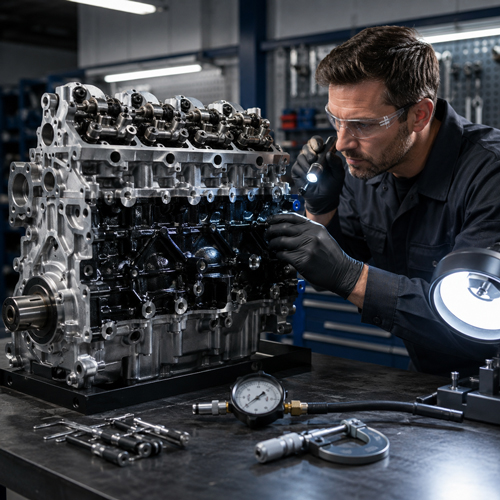
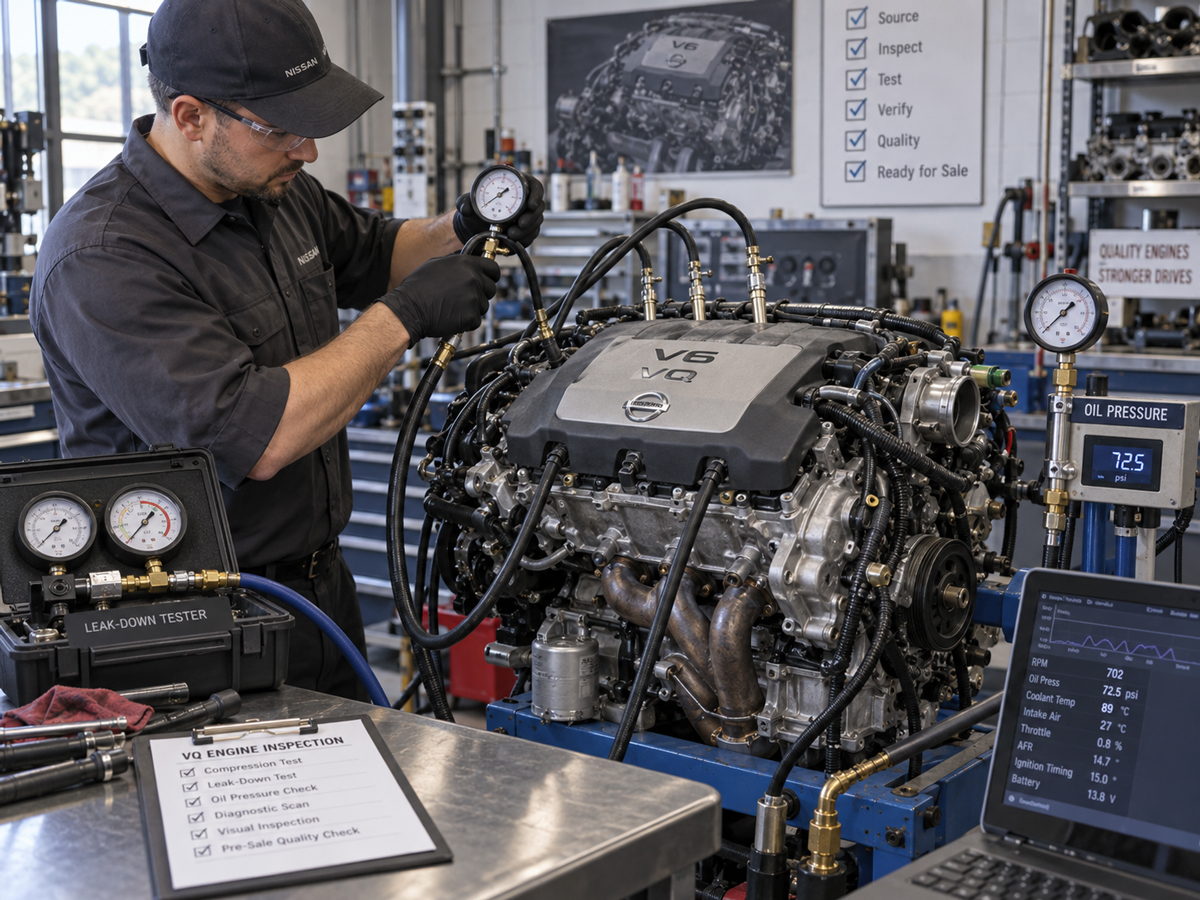
For importers, distributors, and repair shops sourcing a VQ engine on the global market, a handful of checks separate a reliable long-term supplier from a gamble. First, confirm the exact engine code—VQ35DE, VQ35HR, and VQ37VHR are not interchangeable despite sharing the VQ name, and the difference between a VQ35DE and a VQ35HR can mean the difference between a plug-and-play install and a wiring headache. Second, insist on documented testing: a compression test across all six cylinders, a leak-down assessment, and evidence that the timing components and oil-pressure hardware have been inspected. Third, verify the source of the complete engine assembly, including whether it has been hot-tested, cold-tested, or simply pulled and palletized. Finally, ask about warranty. A supplier confident in its engines will back them with a meaningful guarantee, and that confidence is the single best signal of quality in a market where provenance is everything.
Fuchuan Engine has spent more than a decade supplying tested engine assemblies, cylinder heads, cylinder blocks, and turbochargers to buyers across six continents. Our Guangzhou facility maintains an inventory spanning more than 800 vehicle models, including VQ-series units and the platforms they power, and every engine we ship is tested and backed by a 12-month warranty. For distributors looking to source in volume, our OEM/ODM service can also develop and manufacture engines to a partner's specification.
Conclusion
The Nissan VQ engine earned its place in history the right way—not with a single headline-grabbing power figure, but with fourteen consecutive years of Ward's 10 Best recognition built on refinement, precision, and an unusually deep tolerance for hard use. From the VQ30DE to the VQ37VHR, it proved that a naturally aspirated V6 engine could be smooth enough for a luxury sedan, strong enough for a sports car, and durable enough to outlast the vehicles wrapped around it.
That reputation is exactly why the VQ remains a cornerstone of the global used and remanufactured engine market today. If you are sourcing VQ-series engines—or any complete engine assembly—for your business, Fuchuan Engine can supply tested, warranty-backed units at competitive volume pricing. Explore our full engine catalog to see our current inventory, or contact us to discuss becoming an authorized distributor through our global agent program and turn a legendary engine into a reliable, repeatable part of your product line.
Engine Purchasing FAQ: MOQ, Lead Time, and Payment Terms Explained
Related Article