How to Choose a Reliable Auto Engine Supplier in China (2026 Guide)

If you've already collected a dozen quotes from Alibaba or trade shows, you know the challenge: everyone claims "100% quality" and "factory direct pricing," but few can back it up. What you need is a systematic way to cut through the noise. That's exactly what follows. We'll cover requirement definition, supplier capability assessment, quality testing standards, export logistics, and a ready-to-use scoring matrix.
Key Takeaways - Define your engine type (new, remanufactured, or OEM/ODM), specifications, and volume before contacting any supplier. Vague requirements lead to mismatched quotes and wasted time. - Prioritize suppliers with IATF 16949 certification and in-house manufacturing (casting, machining, assembly) over trading companies that outsource everything. - Require 100% product testing with documented cold/hot test reports and a minimum 12-month warranty. These are the baseline for any reliable engine supplier in China. - Verify export experience through ISPM 15-compliant packaging, shipping options (sea/air, DDP), and complete customs documentation including certificates of origin. - Use a weighted scoring matrix to compare suppliers objectively. Never decide on price alone; quality and support typically account for 60% of total cost of ownership.
Why Your Choice of Auto Engine Supplier Matters
The Real Cost of a Bad Supplier Decision
The sticker price barely scratches the surface of what an engine actually costs you. When a supplier cuts corners on materials, skips testing protocols, or ships without proper documentation, the real costs surface months later: in warranty replacements, customer chargebacks, and reputation damage that takes years to rebuild.
China produces over 24 million automotive engines annually, more than any other country. But volume doesn't equal uniformity. The difference between a Tier-1 auto engine manufacturer and a garage-shop assembler can mean the difference between a 50,000-mile engine and one that fails at 5,000 miles.
Carlos Mendez, a fleet maintenance manager for a logistics company in Chile, learned this the hard way. He sourced 15 diesel engine assemblies from the cheapest supplier he could find on a B2B platform, saving roughly $300 per unit. Within four months, six of those engines developed head gasket failures. Between replacement parts, labor, and vehicle downtime, his "savings" turned into a $45,000 loss. "I thought I was saving $300 per engine," Carlos recalls. "Turns out I was betting the whole fleet on it."
The takeaway: systematic supplier evaluation beats price-shopping every time. It's the difference between a sourcing partner and a recurring headache. Want to see what a properly documented engine specification looks like in practice? Explore our engine catalog →
What's at Stake for Wholesalers, Distributors, and Workshops
Different buyer profiles face different risks when selecting an auto engine supplier. Wholesalers carry the largest inventory exposure, where a single bad batch can trigger returns from multiple buyers at once. Distributors sit between manufacturer and end-user, so any spike in warranty claims lands on their phone first. Workshops install engines directly into customer vehicles, meaning a premature failure reflects on their service bay, not the factory floor in Guangzhou. For all three, the cost of a poor supplier decision compounds over time.
Step 1: Define Your Specs Before You Talk to Anyone
Engine Types: New, Remanufactured, or OEM/ODM?
Before you contact a single auto engine manufacturer, you need to know exactly what you're sourcing. The three primary categories serve different markets:
-
New engine assemblies are built entirely from new components. They offer maximum reliability and come with full manufacturer warranties. Ideal for premium segments, warranty-critical applications, and markets with strict emission standards.
-
Remanufactured engines are rebuilt using the original engine block and major components, with worn parts replaced to OEM specifications. A proper remanufactured engine supplier restores performance to 95%+ of new-engine levels at 30-50% of the cost. These are ideal for budget-conscious buyers, older vehicle platforms, and emerging markets.
-
OEM/ODM customized engines are built to your specifications, whether that means adapting an engine for a non-standard application, branding it under your company name, or modifying performance parameters. This route requires a supplier with genuine R&D capability, not just assembly capacity.
Your choice here determines which suppliers are even worth evaluating. A factory that excels at remanufactured engines may lack the engineering depth for ODM customization, and vice versa.
Key Specifications to Document
Create a specification sheet before requesting quotes. Include at minimum:
- Displacement and configuration (e.g., 2.0L inline-4, 3.0L V6)
- Horsepower and torque ratings at specified RPM
- Emission compliance (Euro 6, EPA Tier 3, China 6b, depending on your destination market)
- Fuel type (gasoline, diesel, flex-fuel)
- Engine code or OE part number for exact matching
- Compatibility list (vehicle make, model, year range)
Suppliers who receive precise specifications can give you accurate quotes and avoid the "quote-then-revise" cycle that wastes weeks. Those who respond with "we can do anything" without asking clarifying questions are a red flag.
Volume, Budget, and Timeline Planning
Be upfront about your order volume and frequency. Most Chinese auto engine suppliers have MOQs (Minimum Order Quantities) ranging from 1 unit (for sample orders) to 50+ units for production runs. Annual volume commitments can unlock better pricing tiers and priority production slots.
For budget planning, engine assembly prices typically range from $1,500 for basic naturally aspirated units to $15,000+ for high-performance or heavy-duty diesel engines. Factor in 15-20% for shipping, customs duties, and insurance. Lead times run 4-6 weeks from China versus 8-12 weeks from European or North American manufacturers. When you're restocking fast-selling engine models, that difference matters.
Step 2 — Evaluate Auto Engine Supplier Capabilities
Certifications & Quality Management Systems
Start with certifications. They're the quickest filter for separating real manufacturers from resellers:
| Certification | What It Covers | Why It Matters |
|---|---|---|
| ISO 9001 | General quality management | Baseline. Every real factory should have this. |
| IATF 16949 | Automotive-specific quality management | The gold standard for automotive suppliers; requires rigorous process control and defect prevention. |
| ISO 14001 | Environmental management | Required by many OEMs and increasingly by EU importers. |
A supplier with IATF 16949 has invested significantly in automotive-grade quality systems. IATF 16949 means real process control: documented procedures from incoming material inspection through final testing, with full traceability on every batch. When you're evaluating an auto engine supplier China-based or otherwise, IATF 16949 should be a near-mandatory filter.
Manufacturing Capabilities & In-House Processes
Ask whether the supplier actually manufactures in-house or acts as a trading company. The distinction is critical:
- In-house manufacturers control casting, machining, assembly, and testing under one roof. A genuine engine assembly manufacturer maintains consistent quality, faster problem resolution, and lower costs passed to you.
- Trading companies source from multiple unknown workshops. They can't guarantee which factory makes your engines, can't control quality at the source, and add a markup without adding value.
A reliable engine supplier in China will gladly share photos or videos of their production lines, testing equipment, and warehousing facilities. If they're vague or deflective about their manufacturing setup, keep looking.

Product Range & Inventory Depth
One often-overlooked advantage is a supplier's product breadth. A manufacturer that offers complete engine assemblies, cylinder head assemblies, cylinder block units, and turbocharger options gives you a single sourcing partner for multiple needs. This simplifies logistics, consolidates quality accountability, and often unlocks volume discounts across product lines.
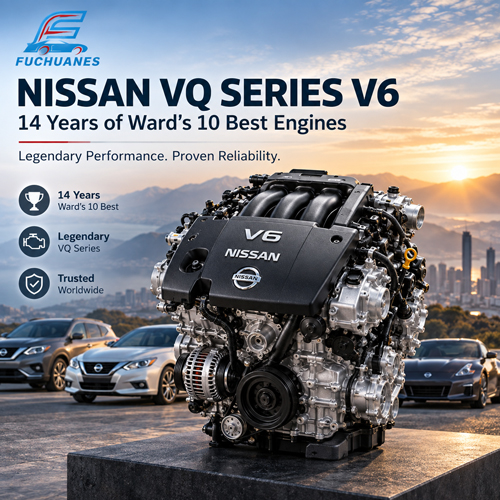
For example, Fuchuan Engine maintains 800+ engine models in inventory, covering Hyundai, Toyota, Nissan, Ford, Mitsubishi, VW, and others. That depth lets them serve as a one-stop engine parts partner rather than forcing you to juggle five different vendors for five different vehicle brands. The real value is inventory control and quality consistency across product lines.
R&D and OEM/ODM Customization
If your business requires branded engines or modified specifications, assess the supplier's engineering depth. Genuine OEM/ODM services require:
- In-house engineering team (not outsourced design)
- CAD/CAM capability for custom modifications
- Prototyping and testing facilities
- Intellectual property protection agreements
- Experience with at least 3-5 OEM/ODM projects (ask for references)
Mariana Torres, owner of an auto parts distribution company in Peru, wanted to build her own brand of replacement engines for the South American market. She initially worked with a supplier that promised OEM capability. What showed up was a stock engine with her logo slapped on the box, not even a changed engine code. After switching to an engine assembly manufacturer with genuine R&D capability, she launched a proprietary engine line that now accounts for a significant share of her revenue. "The first supplier talked a good game about customization," Mariana explains. "What actually arrived was someone else's engine with my sticker on it."
Next step: request sample engines from your top three candidates and test them side by side. A weekend of testing tells you more than a month of emails.
Step 3: Verify Testing Standards (Most Buyers Skip This)
Most buyers never ask about testing methodology. That's a gap, and it's exactly where legitimate manufacturers pull ahead of resellers. Engine testing falls into two categories:
-
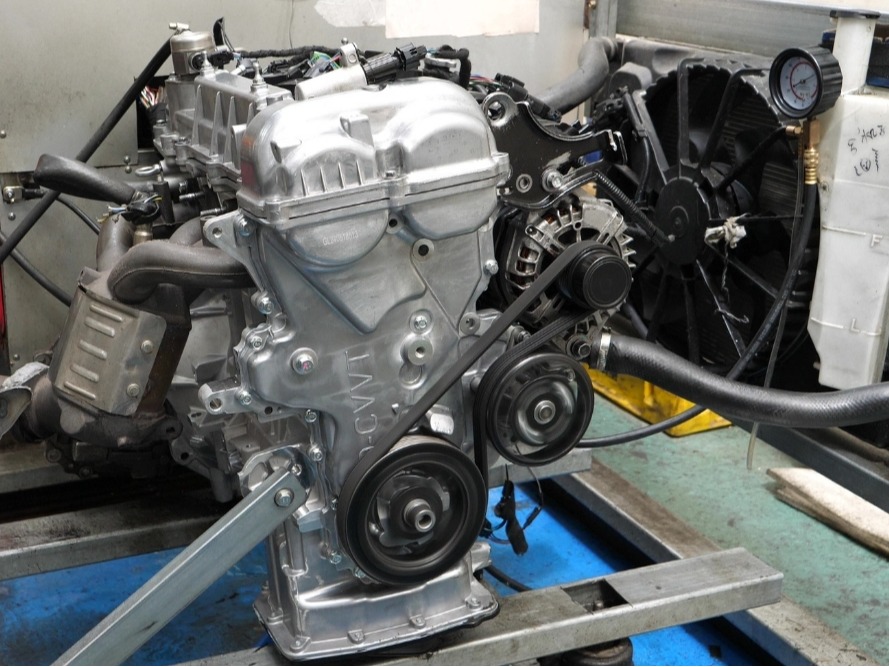
Cold testing runs the engine without fuel or combustion, using external motors to spin the crankshaft. Sensors measure torque, friction, compression, and rotational smoothness. This catches assembly defects (wrong bearing clearances, misaligned components, valve timing errors) at a fraction of the cost of hot testing.
-
Hot testing (also called dynamometer testing) runs the engine under actual combustion conditions with fuel, coolant, and oil. It measures power output, torque curves, emissions, and operating temperature, verified according to SAE engine power test standards. Hot testing catches what cold testing can't: actual combustion performance, emissions, and thermal behavior under load. It's expensive and time-consuming, so not every factory performs it on every unit.
A reputable auto engine manufacturer should perform cold testing on 100% of engines and hot testing on a statistical sample or on-demand for critical applications. Ask for test reports. Real suppliers provide them; resellers can't.
100% Product Testing: What to Ask For
"100% tested" is a common claim. Here's what it should actually include:
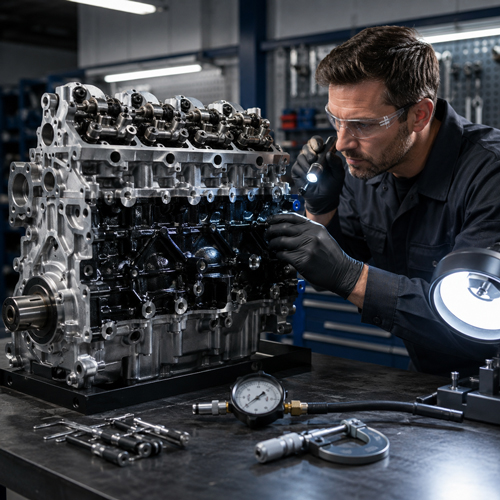
- Dynamic balancing of rotating assemblies (crankshaft, flywheel, pulleys): spinning each unit to detect and correct imbalance that causes vibration and premature bearing wear
- Compression testing to verify cylinder sealing and ring seating
- Leak testing (pressure and vacuum) for coolant and oil passages
- Dimensional inspection of critical tolerances, including cylinder block bore dimensions and piston-to-wall gap
- Performance verification of power and torque output
- Visual inspection for casting defects, machining marks, and surface finish
When 75% of automotive parts manufacturers report implementing strict quality assurance protocols, the other 25% are the ones you need to filter out through verification. A legitimate wholesale engine supplier will provide test documentation for every batch, not just a generic certificate.
Warranty Terms That Actually Protect You
A 12-month warranty is the industry baseline for a legitimate engine supplier. But the duration is only half the story. Coverage scope matters equally:
- What's covered: Engine block, cylinder head, crankshaft, connecting rods, pistons, camshaft, valve train
- What's typically excluded: Consumables (gaskets, seals, belts), damage from improper installation, normal wear
- Claim process: How quickly does the supplier respond? Do they require the failed part returned? Do they cover return shipping?
- Documentation requirements: Installation records, maintenance logs, failure photos
An auto engine supplier that offers 12 months but has no clear claim process or requires six months of paperwork to honor a claim is offering a warranty in name only.
Step 4 — Assess Export Experience & Logistics
Packaging Standards for International Shipping
Engines are heavy, dense, and vulnerable to corrosion and impact damage during transit. A supplier experienced in export will use:
- Fumigation-free plywood crates compliant with the ISPM 15 international standard: no customs delays for wood packaging
- VCI (Volatile Corrosion Inhibitor) packaging: protects bare metal surfaces from rust during 4-6 weeks at sea
- Desiccant packs and moisture barriers: critical for humidity-sensitive components like cylinder head assemblies
- Shock-absorbing materials: foam or rubber padding to protect against handling impacts
- Labeled and palletized: for efficient container loading and customs inspection
Suppliers new to export often use inadequate packaging, resulting in rusted, dented, or damaged engines arriving at your port. Always request packaging photos from previous shipments.
Shipping Methods & Lead Times
China's logistics advantage is significant:
| Method | Transit Time | Cost | Best For |
|---|---|---|---|
| Sea freight (FCL) | 15-35 days | Lowest per unit | Bulk orders, regular restocking |
| Sea freight (LCL) | 20-40 days | Moderate | Small orders, samples |
| Air freight | 5-10 days | Highest | Urgent orders, critical spares |
| Express courier | 3-7 days | Very high | Small parts, documents |
Experienced suppliers offer DDP (Delivered Duty Paid) options, handling all customs clearance and last-mile delivery to your warehouse. This is especially valuable for first-time importers who aren't familiar with their country's import procedures.
Customs Documentation & Compliance
A reliable auto engine supplier should provide complete export documentation as standard:
- Commercial invoice with accurate HS codes (Harmonized System codes, the international standard for classifying traded goods) and declared values
- Packing list (weight, dimensions, quantity per crate)
- Bill of lading (or airway bill)
- Certificate of origin (Form A, Form E, or FTA certificates: preferential origin documents that can reduce your import duties under trade agreements)
- CE certification (for EU-bound shipments)
- Quality and test certificates (matching the engines in the shipment)
Missing or inaccurate documentation causes customs delays that can add weeks to your delivery time and incur storage fees at the port.
Step 5 — Compare Suppliers Using a Scoring Matrix
Supplier Evaluation Scorecard
Never evaluate suppliers on price alone. Use this weighted scorecard to compare candidates objectively:
| Evaluation Criteria | Weight | Score (1-10) | Weighted Score |
|---|---|---|---|
| Quality certifications (IATF 16949, ISO 9001) | 15% | ||
| In-house manufacturing capability | 15% | ||
| Product range & inventory depth | 10% | ||
| Quality testing (100% + documented reports) | 15% | ||
| Warranty terms & claim process | 10% | ||
| Export experience & packaging | 10% | ||
| Price competitiveness | 10% | ||
| Communication & responsiveness | 10% | ||
| Lead time & delivery reliability | 5% | ||
| Total | 100% |
Score each supplier, multiply by weight, and sum for a total. This prevents price from dominating the decision. A supplier with the lowest price but poor testing and no export experience will score far below a slightly pricier but fully capable manufacturer.
Red Flags to Watch Out For
Walk away if you encounter any of these warning signs:
- No verifiable certifications. "We're applying" is not the same as having IATF 16949.
- Refusal to provide factory photos, videos, or a physical address. Suggests a trading company pretending to be a manufacturer.
- Prices 40%+ below market average. Almost always indicates inferior materials or skipped processes.
- No written warranty terms or poor communication during quoting. Verbal promises are worthless across borders, and if they're slow before you've paid, expect worse after.
- No export documentation experience. Customs delays can cost more than the engines.
- Pressure to skip sample orders. Legitimate suppliers encourage sample verification.
New vs Remanufactured Engines: Which Should You Buy?
Your decision between new and remanufactured engines depends on your market position and customer expectations. Here's how they compare across the factors that matter most:
| Factor | New Engine | Remanufactured Engine |
|---|---|---|
| Price range | $2,500 – $15,000+ | $1,500 – $7,500 |
| Performance vs new | 100% | 95%+ |
| Expected service life | Full OEM specification | ~80% of new |
| Warranty | 12-24 months typical | 12 months typical |
| Best for | Premium markets, fleets, warranty-critical applications | Value markets, older vehicles, emerging markets |
| Availability | Current platforms | Broad, including discontinued models |
| Emission compliance | Current standards | Original spec maintained |
For premium markets (North America, EU) and commercial fleets, choose new engine assemblies. For price-sensitive segments, older vehicle platforms, and emerging markets in Southeast Asia, Latin America, and Africa, a quality remanufactured engine supplier delivers 95% performance at 30-50% cost. That value proposition is hard to beat.
Building a Long-Term Partnership with Your Engine Supplier
From First Order to Strategic Partner
How to turn a one-time supplier into a strategic partner? Start by sharing your annual forecast so the supplier can plan production capacity and hold inventory for you. Establish a quality feedback loop: report any field issues promptly with photos and data, and a good supplier will trace the root cause and adjust processes. Negotiate tiered pricing based on cumulative volume, not per-order quantity. Plan joint quality improvement initiatives like factory visits, spec reviews, and test protocol upgrades.
A wholesale engine supplier that knows your business becomes an extension of your operations. They'll flag potential issues before they become problems and prioritize your orders when capacity is tight.
Becoming an Authorized Distributor or Agent
For distributors looking to build a defensible market position, explore whether your supplier offers an authorized distributor or global agent program. These arrangements typically include:
- Territorial exclusivity: you become the sole distributor for a country or region
- Co-branded marketing materials: factory supports your local market development
- Priority production and pricing: your orders move to the front of the queue
- Technical training and support: factory engineers train your team on installation and troubleshooting
- Joint product development: input on which engine models to develop next based on your market intelligence
Ahmed Al-Rashid, a distributor in the Middle East, transitioned from buying engines opportunistically to becoming an authorized agent for a Chinese engine manufacturer. Within two years, his exclusive territory agreement helped him capture a dominant position in the regional replacement engine market. "With the agent agreement, I stopped competing on price with every importer in the Gulf," Ahmed says. "Suddenly I had territory protection and factory support behind me."
If you're ready to explore this path, become an authorized distributor and access a structured global partnership program with dedicated territory support.
Quick Checklist: 10-Point Auto Engine Supplier Evaluation
Before placing an order, verify each item:
- [ ] IATF 16949 certification verified: not just claimed, but confirmed with certificate number
- [ ] In-house manufacturing confirmed: factory photos, video tour, or third-party audit
- [ ] Product range covers my needs: engine assemblies, cylinder heads, blocks, turbos
- [ ] 100% product testing with documented reports: cold test minimum, hot test preferred
- [ ] 12-month written warranty: with clear coverage scope and claim process
- [ ] Export packaging standards met: ISPM 15 crates, VCI packaging, desiccants
- [ ] Complete customs documentation: commercial invoice, packing list, certificate of origin
- [ ] Sample order available: test before committing to volume
- [ ] No red flags from the scorecard: price within market range, responsive communication
- [ ] Reference customers verifiable: at least 2-3 existing buyers in your region
Frequently Asked Questions About Auto Engine Suppliers
What is the minimum order quantity for auto engines from China?
MOQs vary by supplier and product. Many manufacturers accept sample orders of 1 unit for evaluation, while production runs typically require 5 to 50 units. Some suppliers waive MOQs for established customers or authorized distributors of an auto engine supplier. Always confirm MOQ and sample pricing before committing. Reputable suppliers are transparent about their minimums and tiered pricing structure.
How long does it take to ship engine assemblies from China?
Sea freight from China to most destinations takes 15-35 days for full container loads (FCL) and 20-40 days for less-than-container loads (LCL). Air freight reduces transit to 5-10 days but costs significantly more. Add 7-10 days for production and 3-5 days for customs clearance on arrival. Total lead time from order to warehouse is typically 4-6 weeks by sea and 2-3 weeks by air.
Are remanufactured engines from China reliable?
Yes, when sourced from a qualified remanufactured engine supplier. Properly remanufactured engines restore 95%+ of original performance and provide approximately 80% of the service life of a new engine at 30-50% of the cost. The key is verifying that the supplier replaces all worn components to OEM specifications, performs 100% testing, and provides a written warranty. Avoid suppliers who can't document their remanufacturing process.
What certifications should I look for in an engine supplier?
The most important certification is IATF 16949, the automotive-specific quality management standard. ISO 9001 is the baseline that every legitimate manufacturer should hold. ISO 14001 (environmental management) is increasingly required by EU importers. For specific markets, also check for CE certification (EU) and EPA compliance (US). Always verify certificates directly: request certificate numbers and cross-check with issuing bodies.
Can I get OEM/ODM customized engines?
Yes. Many established Chinese manufacturers offer OEM/ODM services, including custom specifications, private labeling, and turbocharger replacement options with performance modifications. Look for a supplier with an in-house R&D team, CAD/CAM capability, prototyping facilities, and signed IP protection agreements. Expect a development timeline of 4-12 weeks for custom projects depending on complexity, and always start with a prototype order before volume production.
Conclusion
Finding a reliable auto engine supplier in China comes down to method, not luck. By following the five-step framework (define requirements, evaluate capabilities, verify testing standards, assess export experience, and compare with a scoring matrix), you can identify suppliers who deliver consistent quality, not just low prices.
Remember: the cheapest supplier is rarely the most cost-effective. Quality, testing, warranty, and export experience collectively determine your true cost of ownership. Use the 10-point checklist before every new supplier engagement, and invest in building strategic partnerships rather than chasing one-off deals.
Need complete engine assemblies, cylinder heads, or turbocharger replacements? Or looking to become an authorized distributor in your region? Fuchuan Engine can walk you through this evaluation checklist step by step. No sales pitch, just a straight answer on whether we're the right fit for your sourcing needs.
Ready to source engines from a manufacturer that checks every box? Contact Fuchuan Engine today for a free quote.
Toyota V6 SUV Platform and the AE86 Legend: A 30-Year Naturally Aspirated Legacy
Integrated Motor Technology of Hybrid Engines: High-Voltage Safety and Cooling Design
Related Article